LATEST POSTS.

Get featured
on Skene!

two actors engage in a choreographed fight with swords
source: Frank Minjarez/ Pexels..

Stage combat is the choreographed performance of violence for a live audience, in which trained performers execute fights that appear real while remaining safe and repeatable, using rehearsed technique, controlled distance, and precise timing under the direction of a fight director.

The most useful thing to understand about it is that a stage fight is choreography. The performers are not opposing each other. They are partners executing a sequence they have both memorized, and the violence exists entirely in the audience’s perception.

Abingdon Theatre Company - Season 34
advertising
skene algorithm
advertising

How a Stage Fight Creates the Illusion

Every technique in stage combat exists to solve the same problem: making contact look like it happened when it did not.

The tools are consistent across styles:

  • Distance. Most blows are thrown to miss, often by more than the audience can perceive from their seats.
  • Angle and sightline. A punch that appears to land from the front row may be nowhere near the face from the wings. Fights are staged for a specific audience position.
  • The knap. The sound of impact, produced by one performer striking their own hand, chest, or thigh, timed to the visual moment of contact. Sound convinces the ear before the eye can object.
  • Cueing. Performers make eye contact before an attack. Each move is a signal, and the sequence only proceeds when both partners confirm readiness.
  • Victim control. The person receiving the blow generates the reaction and often controls the timing. The aggressor’s job is to be predictable.

That last principle inverts what most people assume. In a well-built fight, the attacker is the passive one.

Who Choreographs and Oversees a Fight

The fight director creates the choreography and holds responsibility for its safety. They work from the script and the director’s staging, then build a sequence that tells the story of the fight while staying within what the specific performers can execute reliably.

Fight directors are hired for the rehearsal period and typically leave before opening. On productions with substantial violence, a fight captain is appointed from within the company to maintain the choreography through the run, lead the fight call before each performance, and flag anything that has drifted.

The distinction matters because fights decay. Performers get comfortable, tempos creep faster, and margins that were generous in week one quietly disappear by month three. Somebody has to be watching for that.

Two actors in costume engage in a fight while filming a scene.
source: Cottonbro/ Pexels.

Types of Stage Combat

Training is organized by weapon discipline. The Society of American Fight Directors formally recognizes eight: unarmed, rapier and dagger, two-handed sword, single sword, smallsword, sword and shield, staff, and knife. Individual teachers cover other weapons, but those eight are the ones the SAFD tests in.

Unarmed and rapier and dagger function as the foundation. Most performers begin there, and most training programs treat them as core.

Theatrical firearms sit apart, governed by separate protocols and, in many jurisdictions, by law. Screen combat is also a distinct skill: film fights are built for a camera that can be moved and cut, which permits closer contact and shorter sequences than a live audience watching continuously from a fixed angle will accept.

Safety and Rehearsal Practice

The practices are not negotiable and they are the same everywhere.

Every performance is preceded by a fight call, a full run of the choreography at reduced speed with the cast and crew who are involved. Weapons are inspected before each use, and any weapon showing damage comes out of the show until it is repaired or replaced. Stage management schedules and supervises the fight call and documents any incident.

Three rules underpin all of it. Fights are never improvised. Fights are never performed faster than they were rehearsed. Any performer may stop a fight at any moment without explaining why first.

A performing arts teacher will usually put it more bluntly to students: the fight you can execute at half speed with total accuracy is the fight you have. The one you can only manage at full speed on a good night is not.

Training and Certification

In the United States, the SAFD structure requires at least thirty hours of training in a discipline with a certified teacher, after which the student performs a staged fight before an adjudicator. Work that satisfies the criteria for safety and dramatic effectiveness earns a certificate of proficiency, renewable through a condensed version of the same test.

A point of nuance worth knowing before you put it on a résumé: as HowlRound has reported, the SAFD is emphatic that a proficiency is not a certification. It records that a performer executed specific techniques safely on a specific day. It does not qualify anyone to choreograph a fight.

Structures differ internationally. The British Academy of Stage and Screen Combat certifies across nine weapon systems, and British Equity has recognized its advanced certificate as a route toward the Equity Fight Directors’ Register, a formal pathway with no direct American equivalent.

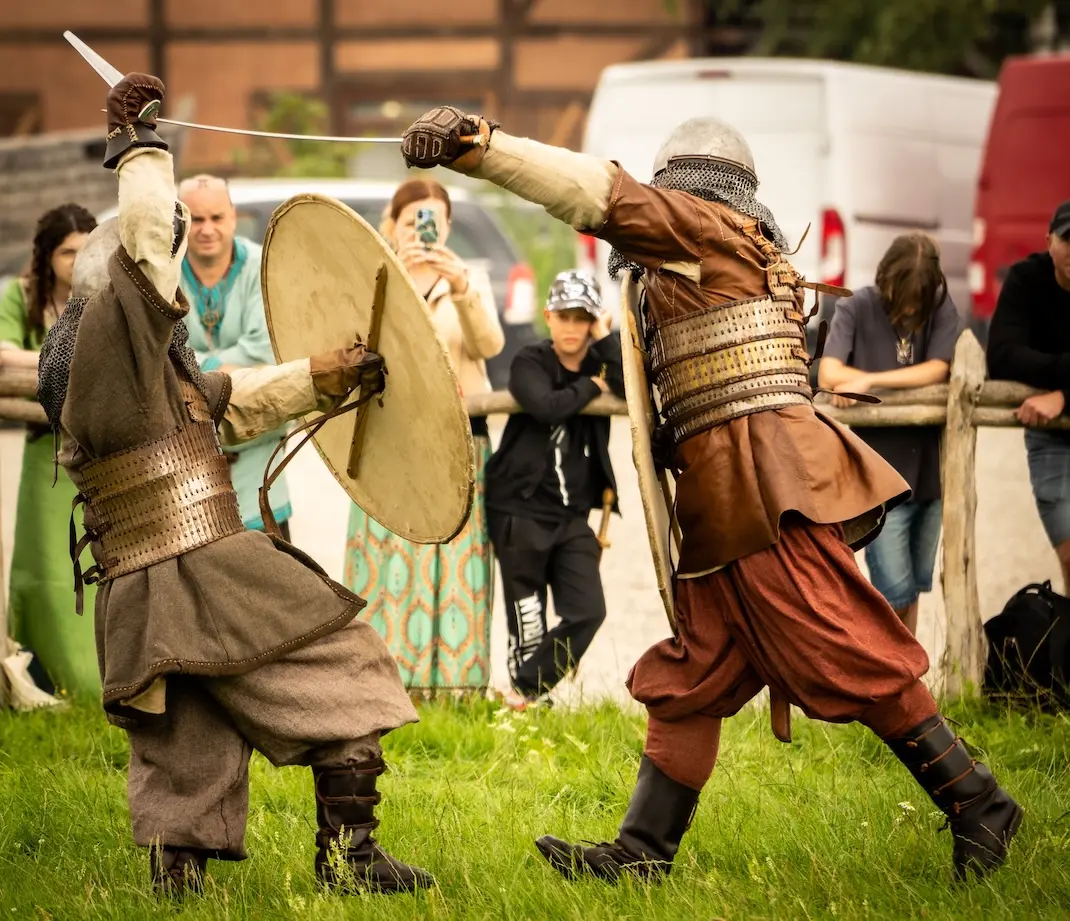
two actors in medieval garb fight in armmor at a rennaisance fair
source: Sebastian Dziomba/ Pexels.

Conclusion

Stage combat is a performance discipline built on cooperation disguised as conflict. The technique is real, the training is rigorous, and the fight itself is a rehearsed sequence with a named author.

The most convincing fight an audience will ever see is not the one performed hardest. It is the one rehearsed most.

FAQs

Do actors ever get hurt doing stage combat?

Injuries happen, and the field’s safety practices exist because of them. Most incidents trace to the same causes: choreography performed faster than rehearsed, a skipped or shortened fight call, fatigue late in a run, or a change made without the fight director present. Trained performers working within an intact protocol are unlikely to be seriously hurt, which is precisely why the protocol is treated as non-negotiable.

Are the weapons in stage combat real?

Usually real metal, but built differently. Theatrical swords are unsharpened, weighted and balanced for repeated stage use, and constructed to survive impact that would damage a historical weapon. Knives may be blunted steel, rubber, or retractable depending on the moment. They are genuine equipment requiring genuine maintenance, and a damaged weapon is removed from the production rather than used carefully.

What is the difference between stage combat and intimacy direction?

Both choreograph physical contact between performers to make it safe, repeatable, and expressive, and both use consent-based practices and rehearsed sequences. Stage combat covers violence. Intimacy direction covers intimate and sexual content. The disciplines developed separately, are trained separately, and are usually held by different specialists on a production, though the underlying logic is closely related.


CITE THIS ARTICLE

Skene Staff. “What Is Stage Combat?” Skene, 29 Aug. 2026, https://skene.pub/what-is-stage-combat/.

Share this post

partner content

RELATED POSTS.

FREE FOR ARTISTS

Get the 2026 Performing Arts Survival Guide.

Practical career guidance for performing arts artists and makers. Take it with you.