Disclosure: Some links in this article may be affiliate links. If you make a purchase through them, we may earn a small commission at no additional cost to you. These links help support the work behind Skene.
Constraints breed clarity. When you have a limited budget, a small rehearsal space, and actors who are learning their craft, the best plays are the ones that demand nothing except listening, presence, and truth. This collection gathers six contemporary plays that require minimal technical support, straightforward sets, and small casts. What they offer in return is sophisticated storytelling, complex characters, and the kind of emotional depth that teaches young performers what it means to trust their scene partners and their audience. These plays prove that constraint doesn’t diminish theatre. It focuses it. When a play has no elaborate scenery to hide behind, every word matters. Every gesture carries weight. Every pause becomes meaningful. Student drama clubs and independent theatre groups operating on tight budgets will find that these plays don’t ask them to do more with less. They ask them to do exactly what matters: speak clearly, listen deeply, and let the audience watch human beings in real conflict. That’s where the power lives. That’s where the learning happens.
Plays About Power, Privilege, and Inherited History
Some plays understand that intimacy is the greatest asset a theatre can offer. When the cast is small and the stage is spare, every actor becomes essential. The audience can’t hide in a crowd or distract themselves with spectacle. They have to watch, listen, and connect. The plays in this section use constraint as a creative strategy. They ask actors to be vulnerable and precise. They trust audiences to sit with silence and complexity. These are plays where a single word spoken with intention carries more weight than an explosion or a chase scene. Student drama clubs that produce work like this teach their audiences and their performers something crucial: that theatre is about presence, not production value.
Speech & Debate
Speech & Debate By Stephen Karam
Three teenagers. A high school auditorium. The worlds they’re building in their heads. Speech & Debate follows Diwata, Solomon, and Howie as they navigate friendship, ambition, identity, and desire through the rigorous world of competitive speaking and debate. Karam writes dialogue that is precise, funny, and deeply honest about what it means to be young and searching. The play unfolds through monologues, scenes, and overlapping dialogue that creates momentum without requiring movement around the stage. One interior set, minimal props, three strong young performers. The play teaches actors what it means to carry a scene through language and emotional truth alone. The dialogue is contemporary and smart. The characters are fully realized people, not types. Audiences will recognize the specificity of adolescent intensity and the ways friendship both saves and complicates everything.
Cast: 3 actors (flexible casting). High school students. Contemporary dress. Single interior location (auditorium, school hallway, or neutral space). Minimal set pieces. Best for high school or college. 110 minutes.
A community theater workshop. Six adults. Seven days. What happens when strangers gather to do theatre games and exercises designed to build trust and connection. Circle Mirror Transformation is a play about how fragile connection is and how desperate people are to be seen. Baker creates a comedy of discomfort and tenderness. The play has almost no plot in the traditional sense. Instead, it unfolds through theatrical exercises that become real and vulnerable. The set is a bare room. The props are minimal. What the play demands is actors who can be genuinely awkward, genuinely funny, and genuinely moved. It’s a masterclass in what happens when you remove distraction and force people to be present with each other. Student drama clubs will find this play liberating. It proves that not every story needs action or plot. Sometimes the story is what happens when people let themselves be changed.
Cast: 6 adults (flexible casting). Contemporary dress. Single interior location (community center, studio, or bare room). No set required. Best for college or advanced high school. 95 minutes.
Plays About Power, Privilege, and Inherited History
Theatre becomes political when it examines systems: how power accumulates, who gets to speak, what we inherit from history without choosing it. The plays in this section are sharp-eyed about race, class, and the ways institutions protect themselves. They don’t offer easy answers. Instead, they ask audiences to witness complexity and sit with discomfort. These plays require actors who can hold multiple truths at once and audiences who are willing to examine their own complicity. Student drama clubs that tackle work like this are making a statement about what theatre can do: hold up a mirror to the world and ask what we see.
Appropriate
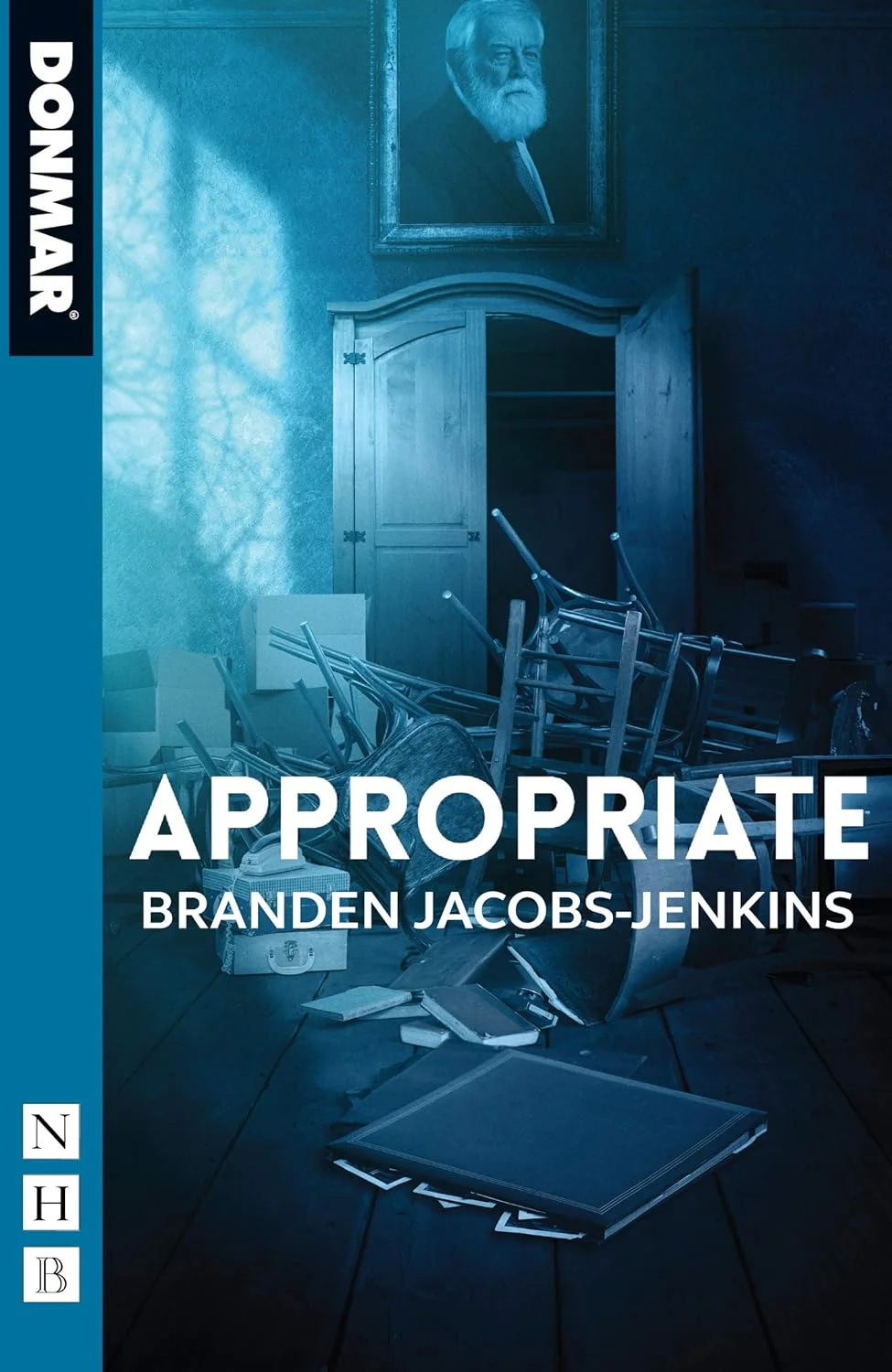
Appropriate By Branden Jacobs-Smith
A Southern family gathers to clean out their father’s house after his death. In the attic, they find a collection of racist memorabilia from American history. What unfolds is a family argument about inheritance, complicity, and whether anyone is truly innocent. Jacobs-Smith writes with surgical precision. The play never lets any character off easy. The mother wants to believe in her family’s goodness. The adult children want to believe they’re different from their parents. The younger generation wants simple answers. None of that works in this play. The dialogue is sharp and specific. The set is minimal (a house, an attic). The cast is flexible. What the play demands is actors who can speak clearly and audiences who are willing to sit with moral ambiguity. This is difficult, necessary work.
Cast: 4–7 flexible (originally 4 adults, 1 child). Contemporary dress. Single interior location (family home). Minimal set. Best for high school or college. 150 minutes.
Content Note: This play contains racism and racist imagery. Consult with a dramaturg or institutional advocate to ensure appropriate support for your cast and audience.
Get Off-Book, Skene’s free newsletter for artists and makers—plus the 2026 Performing Arts Survival Guide.
Clybourne Park
Clybourne Park By Bruce Norris
Two scenes. Two families. Fifty years. Clybourne Park is a sharp response to A Raisin in the Sun. In the first scene (1959), a white family is leaving their neighborhood because a Black family is moving in. In the second scene (2009), a white family is moving into a formerly Black neighborhood. Norris writes a comedy about how we tell ourselves stories about progress while patterns remain unchanged. The dialogue is witty and cutting. The play has no elaborate set requirements. It asks actors to understand the mechanisms of racism and privilege well enough to land both the comedy and the cruelty. The second scene is messier and more contemporary, but both scenes teach audiences how little and how much has changed. This is sophisticated political theatre that trusts its audience to understand complexity.
Cast: 5 actors (flexible, multiracial casting essential). Contemporary dress. Single interior location (house/living room). Minimal furniture. Best for college or advanced high school. 150 minutes.
Content Note: This play contains racism and racial slurs. Consult with a dramaturg or institutional advocate to ensure appropriate support for your cast and audience.
The most powerful theatre happens when you remove everything except human beings in conflict. No elaborate sets. No special effects. No distractions. Just language, gesture, and the space between people trying to connect or destroy each other. The plays in this section understand that constraint forces precision. When there’s nowhere to hide, every choice matters. Student drama clubs that produce work like this learn what it means to create theatre where the human being on stage is the only spectacle that matters.
Tribes
Tribes By Nina Raine
A deaf man. A hearing family. Hearing aids and sign language and the collision of two different ways of being in the world. Tribes is a play about communication, belonging, and what it means when people genuinely don’t speak the same language. Raine writes with tenderness and humor. The play moves between scenes with family members and scenes with a deaf girlfriend who speaks a different language entirely. The staging is simple. The set is a living room. The power comes from dialogue, from the moments of genuine connection and genuine misunderstanding. The play requires one deaf actor and hearing actors who are willing to listen deeply. It teaches audiences about deaf culture and experiences they may never have encountered. It teaches performers what it means to adapt and listen when conversation breaks down.
Cast: 5 actors (1 deaf actor essential, 4 hearing actors). Contemporary dress. Single interior location (living room). Minimal furniture. Best for high school or college. 100 minutes.
An elderly couple in a house by the sea. A storm approaches. A visitor arrives. Time moves strangely in this play. Zeller creates a world where past and present collapse into each other, where memory is unreliable, and where the characters can’t quite remember what happened or when. The play has no elaborate set requirements, though it requires actors who can shift between clarity and confusion, between different versions of the same moment. The dialogue is poetic and precise. The play teaches audiences about aging, memory, and the ways love persists even when everything is uncertain. It requires actors who can hold contradiction: being young and old, certain and confused, in the same scene. The simplicity of the staging forces audiences to focus entirely on the actors’ faces and the language they speak.
Cast: 3 actors (flexible, originally 1 elderly woman, 1 elderly man, 1 visitor). Contemporary dress. Single interior location (house). Minimal furniture. Best for college or advanced high school. 90 minutes.
These six plays share something essential: they understand that constraint is a gift, not a limitation. When you have no budget for elaborate sets and no space for large casts, the plays that shine are the ones that demand everything from language, listening, and human presence. A student drama club that produces one of these plays will discover what it means to direct actors toward precision rather than distraction. Your audience will leave understanding that theatre doesn’t happen on the set. It happens in the space between people, in the words they choose, in the moments they listen to each other. That’s where the power lives. That’s the work worth doing.
We use cookies to ensure our website functions properly, improve your browsing experience, analyze site traffic, and support personalized content. For more information, see our Cookie Policy.
Functional
Always active
The technical storage or access is strictly necessary for the legitimate purpose of enabling the use of a specific service explicitly requested by the subscriber or user, or for the sole purpose of carrying out the transmission of a communication over an electronic communications network.
Preferences
The technical storage or access is necessary for the legitimate purpose of storing preferences that are not requested by the subscriber or user.
Statistics
The technical storage or access that is used exclusively for statistical purposes.The technical storage or access that is used exclusively for anonymous statistical purposes. Without a subpoena, voluntary compliance on the part of your Internet Service Provider, or additional records from a third party, information stored or retrieved for this purpose alone cannot usually be used to identify you.
Marketing
The technical storage or access is required to create user profiles to send advertising, or to track the user on a website or across several websites for similar marketing purposes.