What Does a Props Master Do?
What does a props master do? How theatre props are found, built and managed, from

What does a props master do? How theatre props are found, built and managed, from

Explore Buenos Aires’ independent theatre gems like Teatro Timbre 4, Teatro del Pueblo, and El
What is a skene? The stage building behind the orchestra in Greek theatre, how it

Scenic designer whose work is built on a single principle: never make an arbitrary choice.

Lighting designer Jacob Zamarripa on telling a story without words, the invisible world beneath a
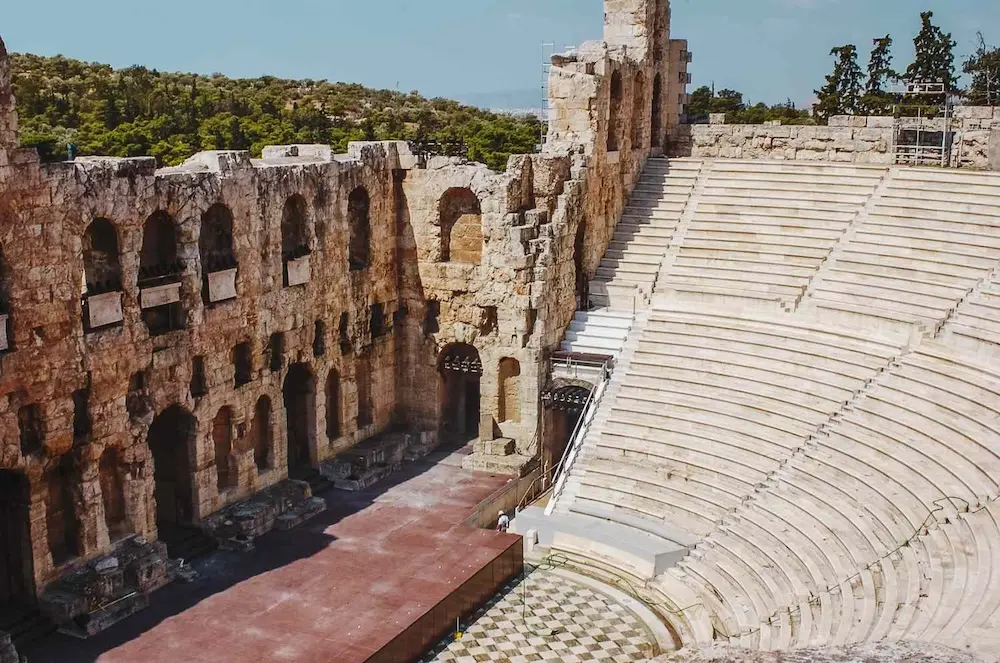
The skene was the stage building at the back of the playing area in ancient Greek theatre, a structure that served as backstage, backdrop and doorway all at once. The name comes from the Greek skēnē, which means ‘tent’ or ‘hut’, and that’s roughly what it was at first: a temporary shelter where actors changed masks and costumes out of the audience’s view. (Wikipedia)
From that modest beginning came the stage house, the painted backdrop and the very word scene. Understanding the skene means understanding where theatre first drew a line between what the audience sees and what it doesn’t.
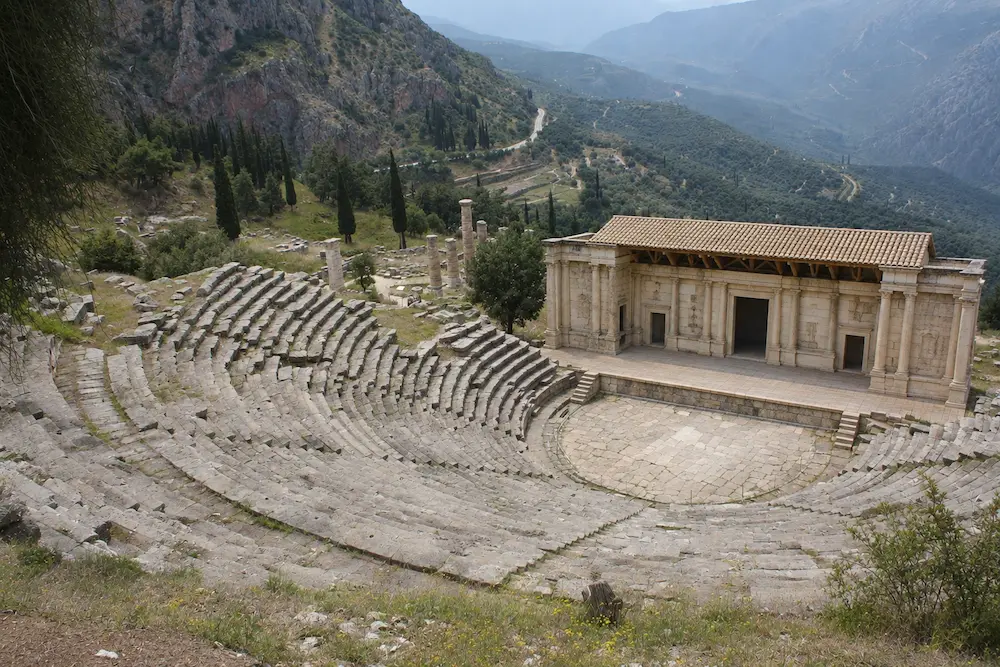
A Greek theatre had three main parts. According to Britannica, the audience sat in a tiered semicircle facing the orchestra, a flat circular space where the action took place. Behind the orchestra was the skene. The orchestra, literally the “dancing place,” belonged to the chorus. The skene stood behind it.
The building did several jobs at once. Actors dressed and changed masks inside it. Its front wall served as the setting of the play, and its doors gave actors a place to enter and exit. LibreTexts describes a small, fairly simple building with three doors called the skene. The door at the center was bigger, while the two side doors were smaller.
The skene wasn’t part of the earliest Greek theatres. Scholars at Didaskalia note that it is possible that there was no skene (stage building) until roughly 460 BCE. Aeschylus’ Oresteia is the earliest extant drama which uses the skene. Before then, actors could only enter by the two side ramps leading into the orchestra.
What began as a light, temporary structure grew heavier and grander over time. By the end of the 5th century bc, the wooden skene was replaced by a permanent stone structure. A raised platform called the proskenion, the “space in front of the skene,” later became the acting area, and its name survives in the modern proscenium. (britannica)
By the Roman period, the hut had become architecture. In Roman theatres, scaenae frons (‘facade of the skene’) is the term for the elaborately decorated stone screens, rising two or three stories, that the skene had now become. (wikipedia)
The skene was a dramaturgical tool as much as a building. Its facade usually stood for a palace or temple, and as one classics lecture from Hampden-Sydney College puts it, it is important to remember that the skene represents the power source in the play. Who enters through the great central door, and who is barred from it, often tells you where authority lies. (hsc)
The skene also kept certain things hidden. It was a convention of the dramas of the classic period that characters never died on stage, instead usually retreating into the skene to do so. The audience heard the cry from behind the wall and imagined the rest. Its flat roof added a second level of performance, mostly representing the appearances of the gods. (4everland, libretexts)
Get Off-Book, Skene’s free newsletter for artists and makers—plus the 2026 Performing Arts Survival Guide.
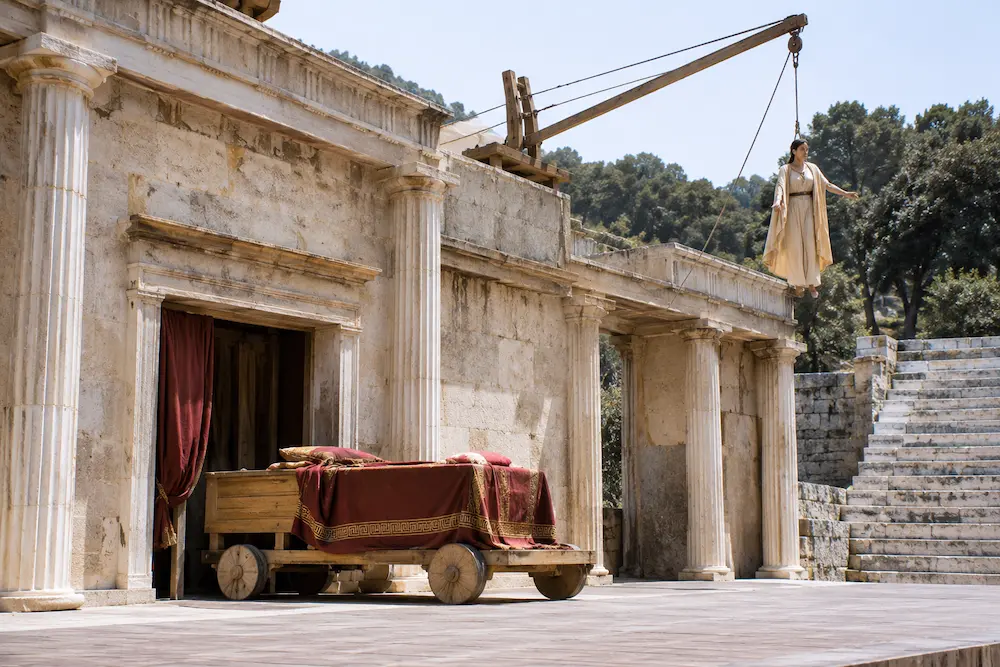
Two pieces of stage machinery worked with the skene. The ekkyklema was a wheeled platform that could be wheeled out into the performance area through the doors of the skene with an actor or actors upon it, often to reveal the aftermath of violence that had happened inside. (Wikipedia)
The mechane was a crane for lifting actors over the skene. It supported the conclusions of plays, whose storylines were often suddenly resolved by the introduction of a god. The mechane is the literal source for the contemporary phrase deus ex machina. Scholars still debate how often fifth-century playwrights actually used either machine, but both are well attested in later sources. (worddisk)
Few theatre terms have traveled as far. The skene gave us scene, scenery and proscenium. It also gave us scenography, the practice a scenic designer carries on today. Even the Greek orchestra survives: what was once the chorus’s dancing floor now names the best seats in the house.
For a designer, the skene is where the craft begins. It was the first permanent surface built to tell an audience where a story takes place, and the first wall behind which theatre kept its secrets.
The skene started as a tent and became a palace, a facade, a hiding place and a machine for gods. It drew the oldest boundary in theatre: between the world the audience sees and the work that makes it possible.
We took our name from it for that reason. Every stage still has a skene, whether or not anyone calls it that.
Is the skene the same as the stage?
Not exactly. In classical Greek theatre, most action happened in the orchestra and in front of the skene, not on a raised stage. The raised platform, the proskenion, developed later, in front of the skene. The skene itself was the building behind the playing area.
What were the other parts of a Greek theatre?
The theatron was the seating area, built into a hillside. The orchestra was the circular floor where the chorus sang and danced. The parodoi were the side passages the chorus used to enter, and the skene was the building at the back.
Did the skene have painted scenery?
Probably. By the time of Aeschylus, the skene came complete with a painted (probably) facade representing the power source of the play, usually a palace or temple. Exactly how elaborate that painting was is still debated. (hsc)
Skene Staff. “What Is a Skene in Greek Theatre?” Skene, 19 Nov. 2026, https://skene.pub/what-is-a-skene-in-greek-theatre/.
Share this story
We use cookies to ensure our website functions properly, improve your browsing experience, analyze site traffic, and support personalized content. For more information, see our Cookie Policy.
Practical career guidance for performing arts artists and makers. Take it with you.