Shuyang Zhou: I Moved a Mountain.
Chinese scenic designer and USITT YDMT award recipient whose work builds worlds


Chinese scenic designer and USITT YDMT award recipient whose work builds worlds

Roberto Mosqueda cuenta cómo escribió La Leyenda del Ermitaño a los 40,

A props master’s field-tested rules for collaboration in the theatre, from doing

Emerging lighting designer whose work on Broadway and beyond is guided by

Six contemporary plays for student drama clubs and theatre groups. Minimal sets,
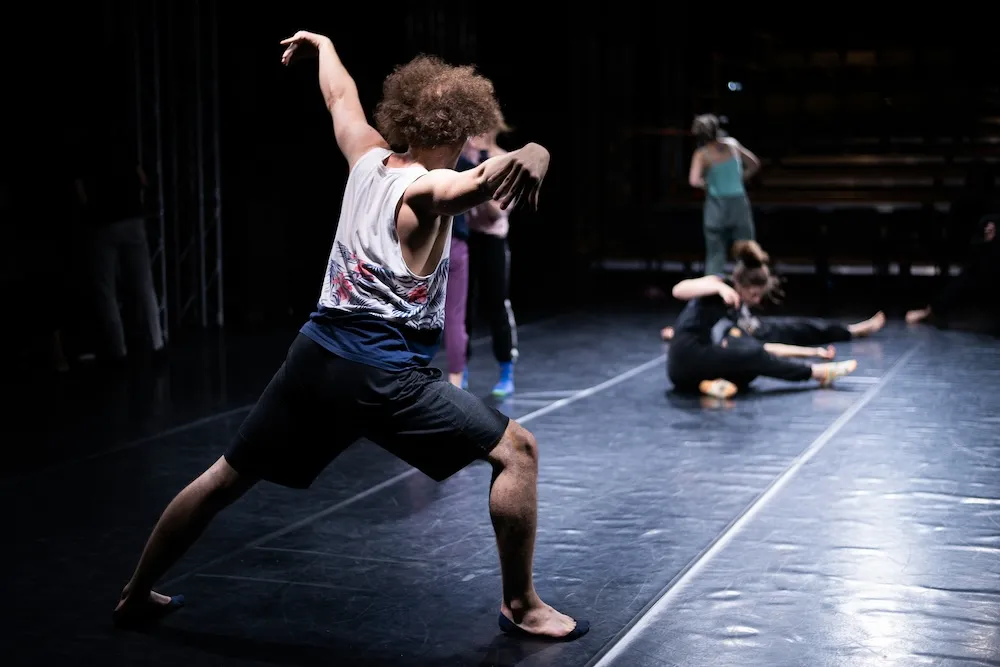
A choreographer designs and teaches movement for a performance, using physical storytelling, dance, and staging to support the director’s vision while collaborating with performers, musicians, and the production team throughout rehearsals.
The most common misunderstanding about the profession is worth clearing up immediately. A choreographer does much more than create dance routines. They decide how movement communicates character, emotion, relationships, and story, then guide performers in bringing that movement to life onstage.
Choreography is the practice of designing movement for performance. In a musical, that may include large ensemble dance numbers. In a straight play, it may involve stylized movement, physical storytelling, or carefully staged transitions. In opera, dance, and devised theatre, movement often becomes one of the production’s primary storytelling tools.
A choreographer typically develops:
The role varies from one production to another. Some choreographers shape movement throughout an entire performance, while others are engaged for specific scenes, dance numbers, or moments requiring specialized physical staging.
The Stage Directors and Choreographers Society (SDC) recognizes choreographers as professional storytellers whose work extends beyond dance technique to encompass staging, collaboration, and artistic interpretation across theatre, opera, and live performance.
Every choreography process begins by understanding the production.
The choreographer studies the script, score, or production concept before meeting with the director and creative team to establish a shared artistic language. Character relationships, dramatic structure, music, and the physical abilities of the performers all influence the movement that follows.
As rehearsals begin, choreography develops through experimentation and revision. Performers explore ideas, directors respond to discoveries, and movement evolves alongside the rest of the production.
The process typically includes:
One important distinction for newcomers: choreography is rarely finished after the first rehearsal. As scenery, costumes, lighting, and performers come together, movement is continually adjusted to better serve the story.
Unlike scenic or lighting designers, choreographers rarely communicate their work through technical drawings. Their primary medium is movement itself.
Depending on the production, a choreographer may provide:
These materials help performers and stage management preserve the choreography consistently throughout the production.
A useful distinction for newcomers: blocking determines where performers move onstage. Choreography determines how and why they move. The two disciplines frequently overlap, but they are not the same thing.
The choreographer collaborates with nearly every artistic department throughout the rehearsal process.
The relationship with the director begins early, ensuring that movement supports the production’s overall storytelling rather than existing independently.
In musicals and operas, choreographers also work closely with conductors and music directors to coordinate movement with musical phrasing, rhythm, and tempo.
Design collaboration is equally important. Scenic designers create the physical environment performers move through, while lighting designers shape how movement is perceived by the audience. Sound designers often coordinate musical and rhythmic transitions that support choreography. Readers interested in those collaborative disciplines can also explore What Does a Scenic Designer Do? and What Does a Sound Designer Do?
Stage managers help preserve choreography after opening by documenting changes and maintaining consistency from one performance to the next.
Choreography combines artistic creativity with leadership and communication.
Successful choreographers typically develop skills in:
Many professional choreographers train through dance conservatories, university theatre or dance programs, or years of professional performance experience. Others come from acting, musical theatre, physical theatre, gymnastics, or related movement disciplines. There is no single educational pathway into the profession.
One of the most valuable lessons newcomers can learn is that successful choreography is not measured by technical difficulty alone. The strongest choreography helps audiences understand a story more clearly, even when they are not consciously thinking about the movement itself.
A choreographer creates the movement language of a production, transforming music, text, and dramatic ideas into physical storytelling that audiences experience through the performers’ bodies.
Whether staging an elaborate musical number or shaping the subtle movement of a dramatic scene, successful choreography gives every movement purpose, helping the story communicate through action as clearly as it does through words.
Does every theatre production have a choreographer?
No. Choreographers are common in musicals, operas, dance productions, and physically demanding plays, but many straight plays rely primarily on the director unless specialized movement is required.
What is the difference between a choreographer and a director?
A director shapes the overall artistic vision of a production, while a choreographer focuses specifically on movement and physical storytelling. The two collaborate closely throughout rehearsals.
Do choreographers need to be professional dancers?
Not necessarily. Many choreographers begin as performers, but others develop expertise through theatre, movement training, teaching, or years of choreographic practice. Strong observation, communication, and storytelling skills are just as important as technical dance ability.
Skene Staff. “What Does a Choreographer Do?” Skene, 29 Aug. 2026, https://skene.pub/what-does-a-choreographer-do/.
Share this post
We use cookies to optimize our website and our service functionalities.
Practical career guidance for performing arts artists and makers. Take it with you.