


LATEST POSTS.

Get featured
on Skene!

What Do Upstage, Downstage, Stage Left and Stage Right Mean?

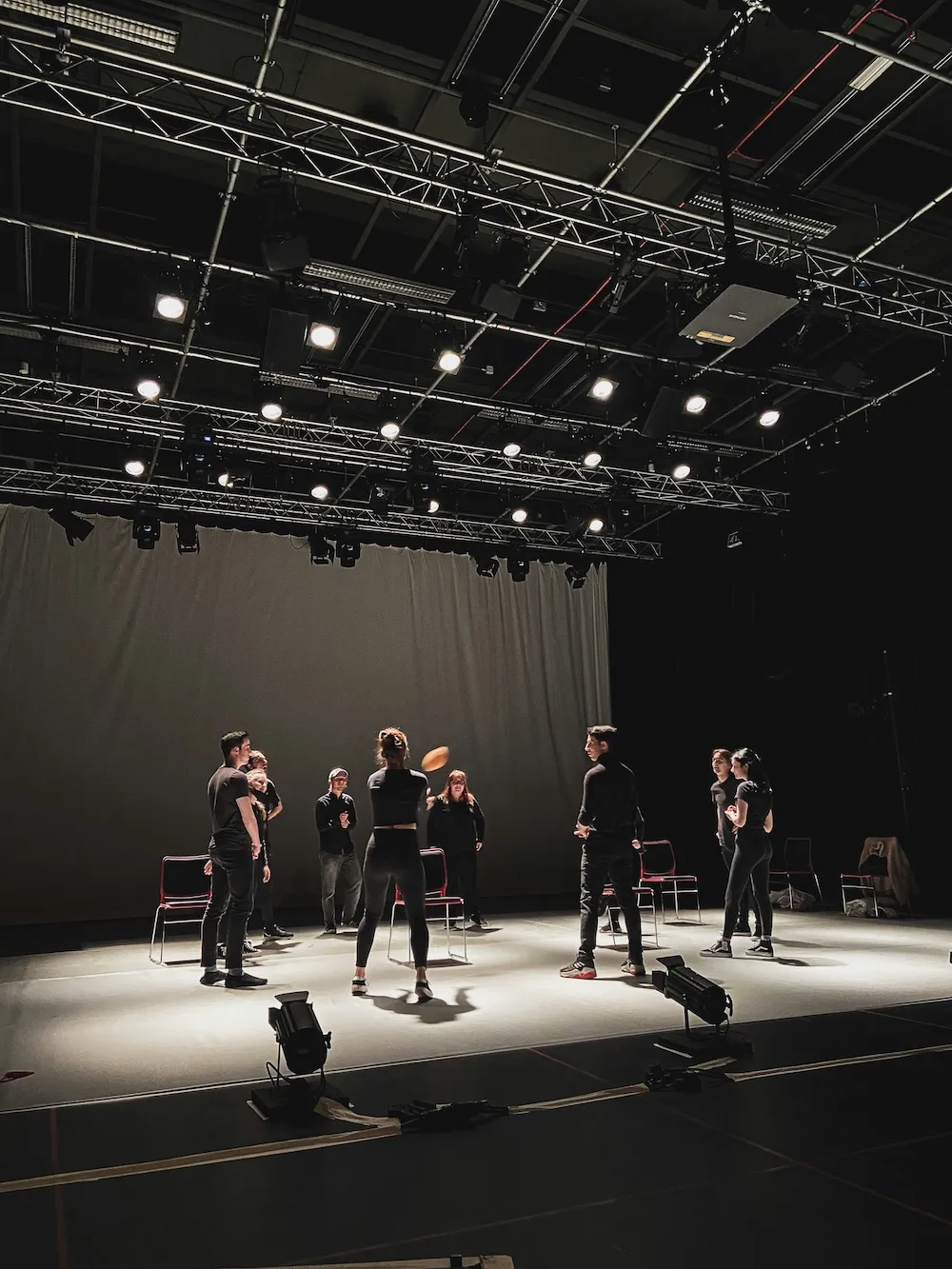
actor rehearsing on an empty stage
Photo by Hamish Kale on Unsplash

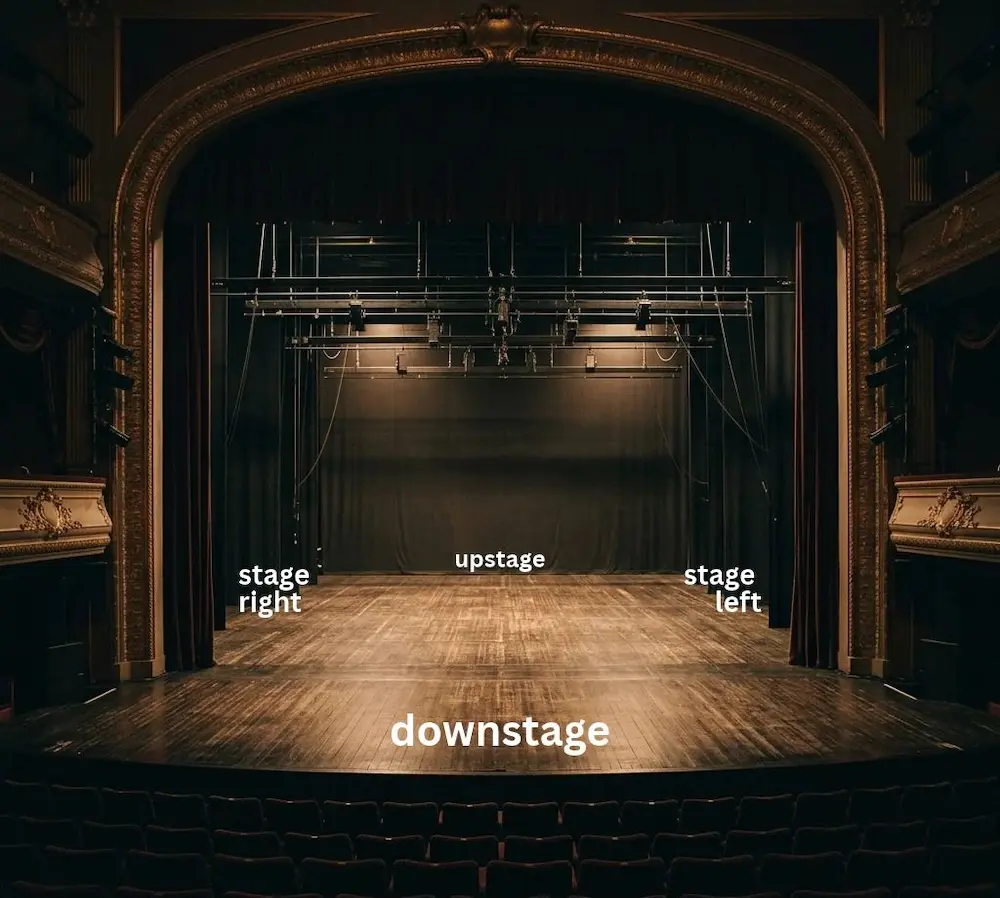
Upstage, downstage, stage left and stage right are the terms theatre artists use to name areas of the stage, always from the performer’s point of view facing the audience. Upstage is away from the audience, downstage is toward it, and stage left and stage right are the performer’s own left and right.

That single rule, the performer faces the house, settles most of the confusion newcomers feel in their first rehearsal. Once it clicks, a director can say “cross downstage left” and every actor, stage manager and designer in the room points to the same patch of floor. This shared map is what makes blocking possible.

Partner content

The Four Basic Stage Directions

Each term names both a place and a direction of travel. The American Association of Community Theatre defines them this way, and the definitions are consistent across the field:

  • Upstage: the area farthest from the audience, toward the back wall.
  • Downstage: the area closest to the audience, near the front edge of the stage.
  • Stage left: the performer’s left when facing the audience.
  • Stage right: the performer’s right when facing the audience.
  • Center stage: the middle of the playing space, the one position that reads the same from every point of view.

“Move downstage” means walk toward the audience. “Cross stage right” means move toward your own right hand as you face the house. Picture yourself standing on the stage, never sitting in the seats.

stage directions chart
Stage directions

Why the Back of the Stage Is Called Upstage

The vocabulary comes from architecture. As TDF’s Theatre Dictionary explains, the terms trace their history to the tradition of “raked” stages, floors that sloped upward away from the audience. An actor walking toward the back wall was literally walking up the stage, and one walking toward the footlights was walking down it. (tdf)

The slope had two purposes: it improved sightlines, and it helps with the illusion of perspective, letting painted scenery appear to recede toward a vanishing point. Most stages today are flat, but the words stayed. (cavac)

The rake also gave theatre one of its best-known verbs. To upstage a scene partner means to position oneself above or further back from them so that they have to turn away from the audience in order to face you. The word now covers any attempt to steal focus, but its origin is purely geometric. (taylorfrancis)

The Areas of the Stage and Their Abbreviations

Combining the four directions divides the stage into a grid. Most companies work with nine areas:

Stage Right Center Stage Left
Upstage UR UC UL
Center R C L
Downstage DR DC DL

Larger stages are often divided further, adding zones such as DRC: Downstage right-center and upstage left-center (ULC). Stage managers use these abbreviations to record blocking in the margins of the script, where speed matters more than full sentences. (dailyactor)

More like this, twice a month.

Get Off-Book, Skene’s free newsletter for artists and makers—plus the 2026 Performing Arts Survival Guide.

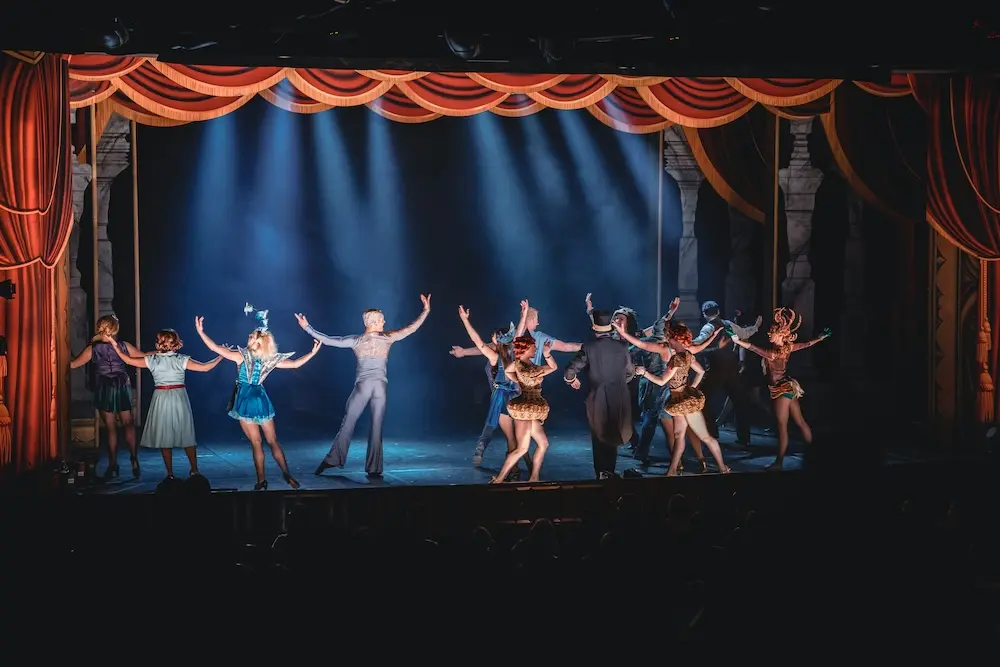
perdormers dancing ona stage covering stage right to stage left
Photo by Yiran Ding on Unsplash

House Left and House Right

The audience has its own set of directions. House left and house right describe the theatre from the point of view of someone seated facing the stage, so they mirror stage directions: stage left is house right. Ushers, the lighting and sound operators in the booth, and anyone describing seats in the auditorium tend to use house directions.

British theatres often avoid the problem altogether with P and OP, short for prompt side and opposite prompt, named for the side of the stage where the prompter traditionally stood. Many actors and directors favour P and OP as they eliminate the sometimes-confusion of having to clarify which person’s left or right is being spoken about. (stagemilk)

How Stage Directions Are Used in Production

In rehearsal, the stage manager writes every move into the prompt book in shorthand: “X DSL” for a cross downstage left. On the floor, small pieces of colored tape called spike marks fix exact positions for furniture and performers, often color-coded by scene.

Designers work from the same map. A scenic designer’s ground plan, the overhead drawing of the set, is laid out from two reference lines: the centerline, running upstage to downstage through the middle of the stage, and the plaster line, usually set at the proscenium opening. Every measurement on the plan starts from those lines, which is how scenery built in a shop miles away lands on the stage exactly where it was drawn. By tech, lighting, sound and scenic cues are all described within the same system.

a ballerina readies herself to go on stage
Photo by Kazuo ota on Unsplash

Conclusion

Upstage, downstage, stage left and stage right are less about memorization than about point of view. Stand on the stage, face the audience, and the map assembles itself.

The words outlived the sloped floors that made them. What remains is a language precise enough that an entire company can find the same spot in the dark.

FAQs

Is stage left the same as the audience’s left?
No. Stage left is the performer’s left while facing the audience, which is the audience’s right. The audience-side equivalent is house left, so stage left and house right point to the same side of the theatre.

Is this the same as the stage directions in a script?
No. In a script, stage directions are the instructions a playwright writes outside the dialogue, usually in italics, describing action, setting or tone. One of the most famous is Shakespeare’s “Exit, pursued by a bear.” Directors treat written stage directions as information about the play, not fixed choreography, and productions often depart from them. (dailyactor)

Do these directions work on a thrust stage or in the round?
On a thrust stage, with the audience on three sides, upstage still points toward the back wall and the vocabulary holds. In the round, with the audience on every side, upstage and downstage lose their meaning, so companies often substitute clock positions, compass points or named landmarks in the room.

CITE THIS ARTICLE

Skene Staff. “What Do Upstage, Downstage, Stage Left and Stage Right Mean?” Skene, 19 Nov. 2026, https://skene.pub/what-do-upstage-downstage-stage-left-and-stage-right-mean/.

Share this story

Leave a Reply

Your email address will not be published. Required fields are marked *

partner content
FREE FOR ARTISTS

Get the 2026 Performing Arts Survival Guide.

Practical career guidance for performing arts artists and makers. Take it with you.