
LATEST POSTS.

Get featured
on Skene!

What Is Blocking in Theatre?

a group of actors move across the stage seen from an establishing shot
source: Ruca Souza/ Pexels.

Blocking is the planned movement and positioning of performers onstage, developed during rehearsals to support storytelling, ensure visibility, and coordinate a production safely and consistently.

The most common misunderstanding about blocking is worth clearing up immediately. Blocking is not simply telling actors where to stand. Every entrance, exit, cross, and moment of stillness is chosen to help tell the story while allowing performers, designers, and technicians to work together effectively.

Partner content

Why Blocking Matters

Every production uses blocking to organize movement onstage. It helps audiences understand relationships between characters, directs attention to important moments, and creates visual compositions that support the story.

Good blocking serves several purposes at once. It can:

  • Focus the audience’s attention
  • Reveal relationships between characters
  • Support the rhythm and pacing of a scene
  • Maintain clear sightlines for the audience
  • Keep performers safe around scenery and technical equipment
  • Create consistency from one performance to the next

One important lesson for newcomers is that good blocking often goes unnoticed. When movement feels natural and motivated, audiences tend to focus on the story rather than the mechanics of how performers move through the space.

How Blocking Is Created

Blocking begins during rehearsals, usually after the director and performers have explored the script together.

The director proposes movement based on the story, while actors discover how those ideas work in practice. As rehearsals continue, movement evolves alongside performances, scenery, lighting, and costumes until the production reaches its final form.

The process typically includes:

  • Reading and analyzing the script
  • Establishing initial staging
  • Exploring movement during rehearsals
  • Revising scenes as performances develop
  • Adjusting movement during technical rehearsals
  • Final refinements before opening

Blocking is rarely finished after the first rehearsal. A doorway may need to move when the scenery is built, an entrance may change because of a costume, or a moment may be restaged after discovering a stronger dramatic choice.

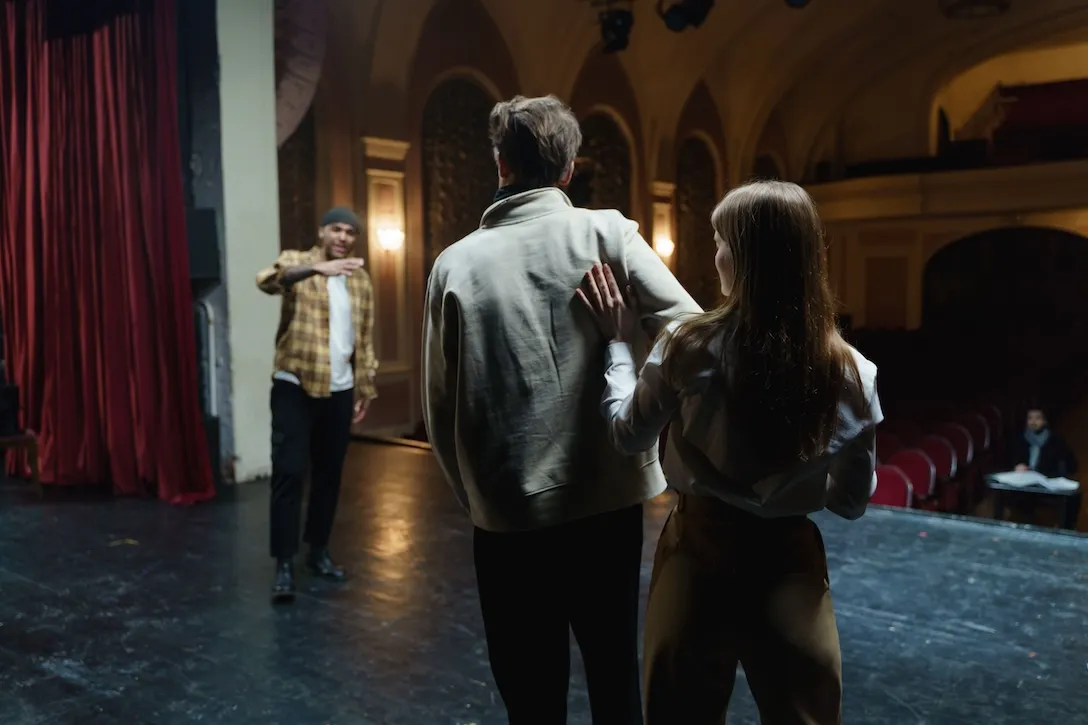
two actors on stage attend the instructions of a director
source: Cottonbro/ Pexels.

Common Blocking Terminology

Many blocking terms describe locations or movement onstage.

Some of the most common include:

  • Upstage: The area farthest from the audience.
  • Downstage: The area closest to the audience.
  • Stage left: The performer’s left while facing the audience.
  • Stage right: The performer’s right while facing the audience.
  • Cross: To move from one place onstage to another.
  • Cheat out: To angle the body slightly toward the audience while remaining engaged with another performer.
  • Spike mark: A small piece of tape marking an exact position on the stage floor for scenery or performers.

Learning these terms helps performers, directors, and technicians communicate quickly during rehearsals.

More like this, twice a month.

Get Off-Book, Skene’s free newsletter for artists and makers—plus the 2026 Performing Arts Survival Guide.

Who Is Responsible for Blocking

Blocking is a collaborative process, but different members of the production team have different responsibilities.

The Theatre Director develops and revises the blocking throughout rehearsals, ensuring that movement supports the story and the overall artistic vision.

Performers learn the blocking, adapting it naturally to their characters while maintaining consistency from one rehearsal to the next.

Once the production opens, the Stage Manager records the blocking and helps preserve it throughout the run, ensuring that performances remain safe and consistent.

Blocking also depends on collaboration with the design team. Scenic designers create the physical environment performers move through, lighting designers illuminate that movement, and choreographers may develop specialized movement sequences that integrate with the staging. Readers interested in those collaborative roles can also explore What Does a Theatre Director Do?, What Does a Stage Manager Do?, What Does a Scenic Designer Do?, What Does a Lighting Designer Do?, and What Does a Choreographer Do?

Does Blocking Ever Change?

Yes, but not randomly.

During rehearsals, blocking often changes as directors and performers discover stronger ways to tell the story. Technical rehearsals may also require adjustments to accommodate scenery, lighting, costumes, or safety considerations.

Once a production opens, blocking usually remains consistent so that every performance can be safely repeated. If changes become necessary, they are typically discussed with the stage manager and, when appropriate, the director.

Maintaining consistent blocking also allows lighting cues, sound cues, scenery, and backstage operations to function as planned. Even small changes in movement can affect many other departments.

source: Fthdgrl/ Pexels.

Conclusion

Blocking is the planned movement that allows performers, designers, and technicians to tell a story together clearly, safely, and consistently.

Although audiences may simply see characters moving naturally through a scene, every entrance, exit, pause, and crossing has usually been carefully considered to support the production’s storytelling.

FAQs

Who writes down the blocking?

In most productions, the stage manager records the blocking in the prompt book during rehearsals so it can be maintained consistently throughout the run.

Can actors change their blocking?

Generally, no. Blocking is developed collaboratively during rehearsals. Once a production opens, changes are usually discussed with the stage manager and, when necessary, approved by the director.

Why are the terms “upstage” and “downstage” used?

The terms come from early theatres with raked stages that sloped upward away from the audience. Performers literally walked “up” the stage when moving farther from the audience and “down” the stage when moving closer.

CITE THIS ARTICLE

Skene Staff. “What Is Blocking in Theatre?” Skene, 29 Aug. 2026, https://skene.pub/what-is-blocking-in-theatre/.

Share this story

Leave a Reply

Your email address will not be published. Required fields are marked *

partner content
FREE FOR ARTISTS

Get the 2026 Performing Arts Survival Guide.

Practical career guidance for performing arts artists and makers. Take it with you.