






by @ginnaalvarez
This column is a Staff translation. The original OPINION column in Spanish can be found here.
Why do Alcoholics Anonymous groups meet? Because they have everything against them
I believe something similar happens in independent theater groups. Both function as communities of resistance against a system that pushes them toward dissolution: one against addiction, the other against the commercialization of art and cultural precarity.
The world around them tempts them with endless distractions from their mission. Yet, some theater groups have endured for decades—through wars, hardship, and pandemics. Perhaps it’s precisely because of this: crises heighten the desire to cling to an ideal as a lifeline.
The theater that interests me most is created by these emerging ecosystems: theater collectives. A blend of individuals who not only gather to rehearse, stage, and premiere a play, but also isolate themselves, concentrate, and immerse in slow processes to develop a shared poetic language.
Perhaps the idea of coming together on a single artistic path with others, until death do us part, may seem like a very anachronistic, romantic, and sectarian notion. But when individuals find accomplices in their convictions, experimental processes that would otherwise be impossible alone become possible.

The Theatrical Scene of Buenos Aires
When I emigrated from Mexico to Buenos Aires, Argentina, in 2014, I found myself in one of those impossible situations: I was alone, unemployed, without any theatrical work, and completely disoriented. I didn’t know the production methods in Capital Federal, the local theatre creators, or even the city’s layout.
Buenos Aires has a vibrant artistic scene, and at that time, there seemed to be a theater on almost every street. Deciding where to begin was challenging in a place where even taxi drivers are experts in Commedia dell’arte. It’s both stimulating and overwhelming, with so much happening everywhere.
Me, I grew up in a desert where doing theater gave you certain outsider status, and it was more or less crucial — and easy — to connect with other outsiders, whether or not there was creative affinity.
In Argentina, I began by watching as much theater as I could, auditioning for both serious and questionable projects — landing roles in both the serious and the questionable. However, none of these were long-term commitments or the kind of project where you can truly explore without knowing what you’ll find. I moved through those rehearsal spaces still craving something more.
While searching for a fulfilling project as an actress, I recalled an old joke that says that to become a theater director, all you need are actors who believe you are one. It sounds terrible, but if you think about it, a leap of faith isn’t a bad starting point for any project — romantic, artistic, or commercial.

The Labyrinth of the Creative Process
I had worked as a director in Mexico, and although I had little experience, I had a strong desire to see certain things happening on stage that I hadn’t yet experienced as an audience member. So, I took two steps that to me seemed logical: I rented a rehearsal space and held auditions. And yes, people did show up. I also attended various workshops led by creators whose stage work moved me. From the actors and collaborators I met in those auditions and workshops, in 2015 La Polenta Teatro was formed.
In the auditions I held, I was less interested in finding fully trained actors and more focused on discovering those who shared the same hunger I had — the desire to form a group deeply lost and in love with the labyrinth of the creative process. Also from those shared artistic impulses La Polenta Teatro emerged.
It wasn’t by design that La Polenta was made up mostly of Hispanic American immigrants. It happened organically — one of those cases of emergent system self-organization, like anthills or those streets where, suddenly, a dozen music shops appear in the same area without prior coordination.
La Polenta Teatro worked for five consecutive years — which sounds simple, but in theater collective terms, that’s like dog years. I believe our group reached its middle age.

The Economy of Resistance
Looking back, the conditions we worked in seem improbable—if not miraculous. All over Buenos Aires, we went on a long exodus through hourly rented rehearsal spaces, sometimes changing locations three or four times a week due to availability issues.
We rehearsed in tiny and huge spaces, ranging from 2×3 meters (7×10 ft) to 10×20 meters (33×66 ft), with or without curtains, lights, or in various unconventional places: apartments, living rooms, warehouses, courtyards, and even a space that had once been a porno movie theatre, with a concrete column in the middle of the stage, in a dangerous neighborhood. Eventually, we found a rehearsal room that met all the necessary conditions to become our theatrical home.
By pooling change and coordinating the schedules of the eleven people who were sustaining the project, we managed to afford 16 hours of weekly rehearsal time: four 4-hour sessions. Some would arrive after long days at their day jobs to rehearse from 8 p.m. to midnight. Many cups of mate were drunk, and plenty of galletitas were eaten.
The group’s finances were based on a simple but effective system: our own piggy bank. Each member of La Polenta contributed a monthly amount, recorded by the treasurer. The contribution wasn’t fixed and varied according to individual circumstances. Sometimes, one member would help another who couldn’t contribute. There were no complaints or envy; everyone wanted the capital to flow. As elementary and precarious as it sounds, this system eventually got us out of the red.

Over time, it was no longer necessary to contribute from our own pockets. For the second production, funding started coming from other sources and institutions for artistic financing. In Argentina, independent theatre refers to theatre not dependent on the State, but in reality, no theatre is truly independent. All theatre depends, in some way, on State subsidies, even commercial theatre. Perhaps it’s called independent because it grows in the cracks, in alternative city spaces, and, most importantly, is not born out of intent to profit.
I have nothing against working on projects to make money. Money is—at times—a good guy. It makes things easier. I’m simply describing that we preferred to obtain it through other means, as long as we didn’t have to compromise the spirit of the project: the love for long paths whose destination was uncertain. Besides, almost all of us lived this kind of double life that made the project sustainable. By day, a salesperson at Zara; by night, an actress. By day, a librarian; by night, a playwright. By day, a flower vendor; by night, an actor. By day, a burger flipper, and so on.
Migrant Theatre
The composition of the group was unexpectedly harmonious: Mexico, Honduras, Argentina, Venezuela, Chile, Ecuador. All accents blended on stage, all bodies, each with its own geography of gestures, customs, and memories.
We became eleven stable members. What we shared in common, above all, was our migrant condition, our love for theatre, and that chronic unease shared by all those born in Latin America—an all-devouring mother who is loved, yet resented.
From our differences arose several performances. For instance, there was Walter, an actor from Mangulile, Honduras, who didn’t know electricity or silverware until the age of eight. Out of this, our production Honduras Sunset was born. There was also Isadora from Ecuador, whose elderly father gave her a pistol when she turned fifteen, which inspired my play Conjuro para Cazar Venados. There was Gabriel and his vast library, Belén with her Portuguese grandmother’s recipes, and Leonardo’s German schooling, Jota and his relationship with textiles and thrift stores, Verónica and her vegetarianism, Armando and his hidden tenderness, Julio and his ability to light with unconventional objects.

We produced and premiered seven theatrical productions over five years and wrote several more. I could share a lot about our rehearsals, the processes, the dead ends, the fights, and the reconciliations, but suffice it to say that rehearsal, for me, was as joyful -if not more- as the performances. In rehearsal, we had those little moments of epiphany, where from a mistake, a pearl was born.
The Legacy of La Polenta
I would like a different type of climax for the third act of this story, but there isn’t one. In 2020, we were ready to go on tour with La Escala Animal. We had adapted the set design to fit into suitcases, packed everything after rehearsal, and distributed the loads. We said our goodbyes, and the next morning, we were in lockdown due to the COVID-19 pandemic.
That rehearsal was the last time I saw some of my colleagues. Many had to return to their countries, either due to lack of income or because a family member was ill.
I don’t know if there’s a moral to the story. What happened to us has happened to many theatre groups throughout history. Perhaps it’s simply the luxury of saying that, although a project might end in its dissolution, that doesn’t mean it shouldn’t be undertaken. It’s the blissful ignorance of allowing yourself to be possessed by hope that makes it possible to take on impossible tasks -like marriage, or writing a novel.
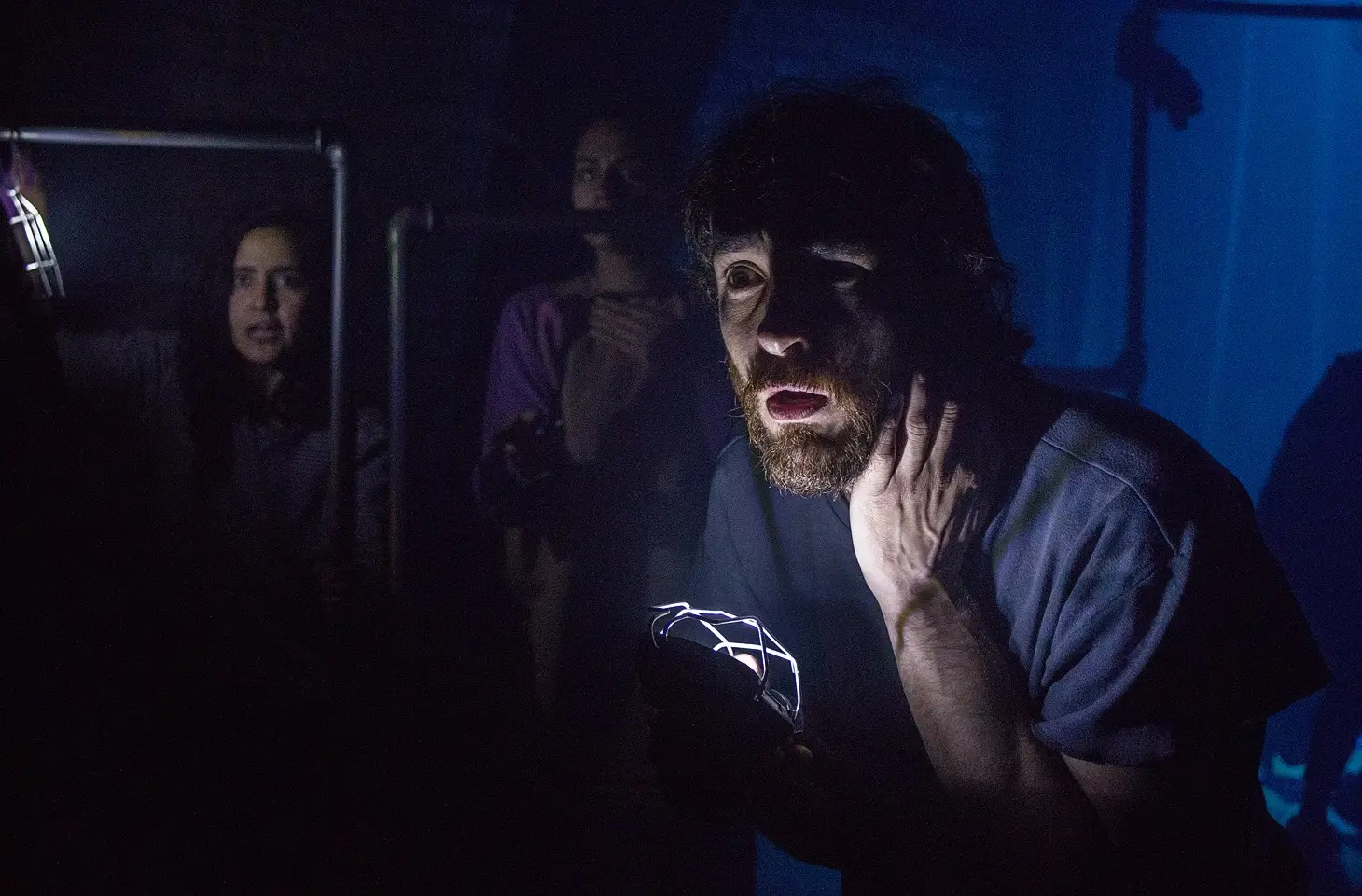
I never thought of the artistic life as a ladder where one premieres shows in increasingly larger and more prestigious venues—today the small grage forum in Buenos Aires, and tomorrow Radio City Music Hall. I always saw each process as its own reward. In these terms, there is no failure. Just experiments that don’t bloom as expected, but shed light and provide information about alternative paths. That’s how I believe every creative process should be.
I made a lot of mistakes directing La Polenta Teatro, but thankfully not enough to stop each member from reaching out every now and then to tell me about their creative endeavors. Sometimes, in the middle of those chats, they say: “Do you remember?!”
Yes, I do remember. I do miss it. I too, resist.
Ginna Álvarez is a director, playwright, actress, musician, and photographer with over twenty years of experience in the performing arts. Her work explores migration, storytelling, and the power of collective human experiences.
You can read more about her journey and artistic vision in her PROFILE feature on SKENE.pub