Jacob Zamarripa: The Invisible World Beneath the Story.
Lighting designer Jacob Zamarripa on telling a story without words, the invisible world beneath a

Lighting designer Jacob Zamarripa on telling a story without words, the invisible world beneath a

Japanese tap dancer Ayaka Ida on theatre tap, golden-age glamour, choreographing as a conversation with

Scenic designer from Malaysia whose patient, research-driven practice builds visual worlds where a single image
La diseñadora Estela Fagoaga sobre su camino de la música al vestuario, fundar Trama y

The Skene TOP 9 for October: nine stories readers chose most, from artist profiles to
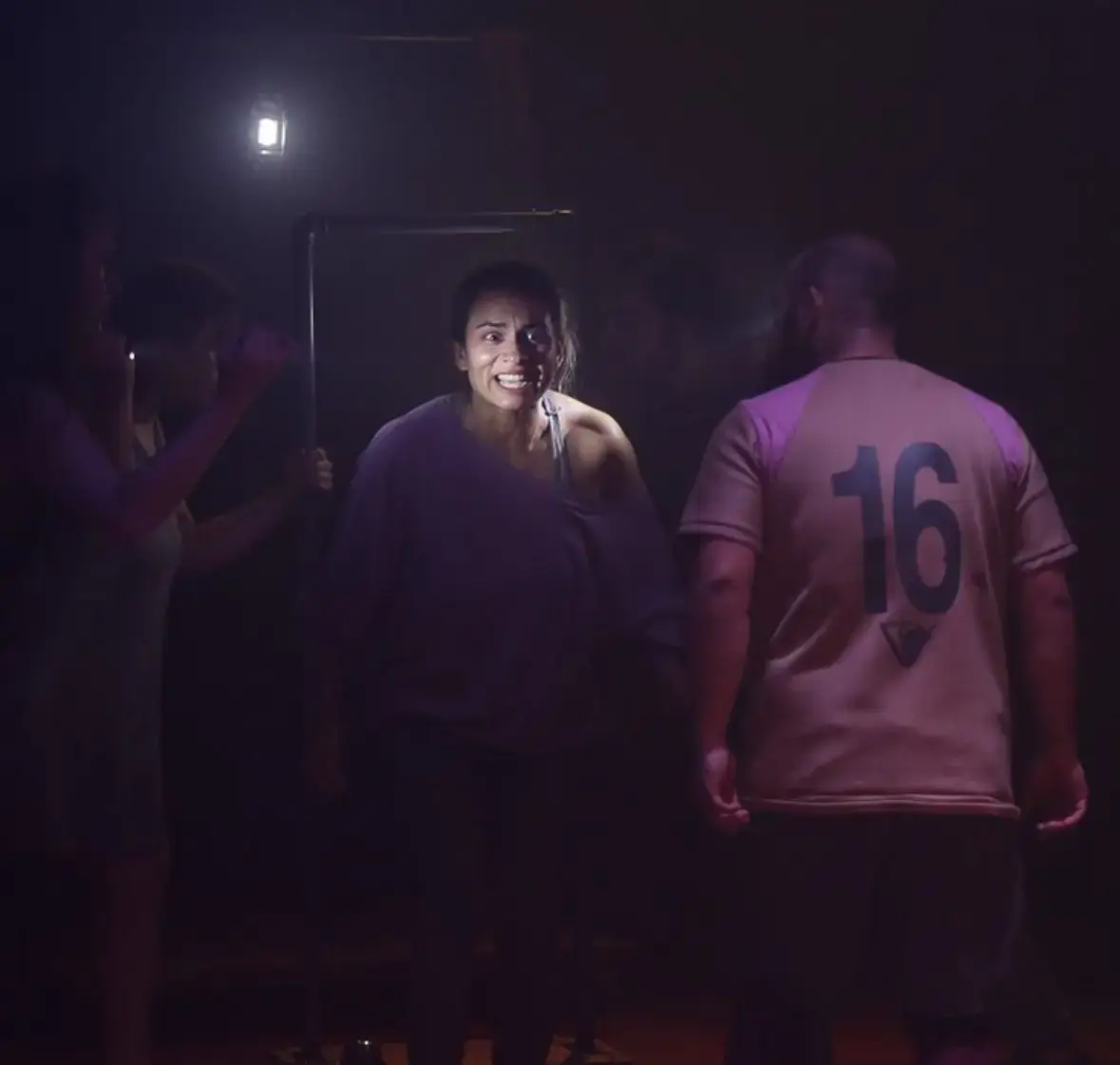
In the world of theatre, few creators possess the ability to shape narratives as powerfully as Ginna Álvarez, a director and playwright whose work constantly pushes boundaries and challenges both the form and function of performance. With a career rooted in a deep understanding of the human experience, Álvarez’s unique approach to theatre delves into the heart of personal and societal transformation. Her creative process isn’t just about crafting a story; it’s about questioning conventions, embracing the unknown, and pushing through the discomfort of self-exploration.
Álvarez’s journey as an artist has been a constant evolution—moving from the playful experimentation of her early days to the sincere, reflective work she creates today. Her theatre is defined by a balance of freedom and structure, of inventing obstacles that both challenge and excite the audience. Through her powerful narratives, Álvarez interrogates not just the nature of theatre, but the very fabric of society and the human condition.
In this edition of PROFILES, Ginna Álvarez opens up about the driving forces behind her work, her challenges, and the artists who inspire her.
I started when I was a teenager, and at that time, encountering new teachers and theories made me focus my thinking on acquiring conventional theatre techniques, on distinguishing between what was “right” and “wrong” in acting practice.
Today, more than technique, I am interested in genuineness and sincerity. Of course, both are important, but if I have to choose, as an audience member, I am more deeply moved in the theatre when a moment of freshness and truth emerges. When I was starting out in theatre, I had that thing young actors have—an immediate connection to playfulness and boldness.
Now, the challenge is to reclaim that audacity in every process, in every rehearsal. But one of the nice things about growing older is that I now have the cunning to invent stimulating obstacles for experimentation and theatrical play. My expectation is always that these obstacles will make the creative process exciting.
My first motivation in theatre—and in the arts in general—has always been to play.
I started doing amateur theatre, both in school and independently. Before that, I already had a long history with creativity—just like every child does, it’s not that I want to make myself seem special. Haha. I was drawn to musical exploration. My favorite toy was a tape recorder that Sony designed for kids; it had a small yellow microphone.
The autonomy of recording was a great starting point because, by accident, play became a bit more serious—I could collect sounds, and collecting is the first part of the creative process. It’s something one does intuitively at that age. So, I would record conversations or bits of music.
I’ve always been inspired to tell stories because listening to stories moves me. Like music, stories have their own rhythm and climax, and when they are well told, just like music, they can become universal. That is what inspires me.
The constant challenge, from adolescence to today, has been the fear of failure, regardless of the context. It is consciously understood that the creative process requires a degree of freedom and boldness that cannot be anchored or hindered by the fear of exposing one’s own shortcomings.
But in every process, there is a moment when doubt arises. Is this a great discovery or a complete foolishness? I know that many creatives may not experience this. There are people who are shameless, brave, or perhaps simply have an immense amount of self-confidence. I don’t have that, but in return, I deeply enjoy the moment when hesitation is overcome in the process.
Growing up in Latin America, I suppose I could also say that the lack of capital, the absence of formal art schools, the disorder, and the indignity of some institutions that should serve artists have been challenges. But I believe those shortcomings have always been allies in the creative aspect. It’s like Edison said: necessity is the mother of invention.
My own migrations have also brought difficulties. Every country has its own creative codes. The differences are subtle, even if there are similarities. For example, when I was in Ireland, I realized they had a very different relationship with the body compared to Mexico, and if I wasn’t careful, I could have gotten myself into serious trouble.
Get Off-Book, Skene’s free newsletter for artists and makers—plus the 2026 Performing Arts Survival Guide.
I don’t know of any work that doesn’t, voluntarily or involuntarily, reflect on the social and cultural reality of its artist. I suppose logic would suggest that it’s best for this process to be fully conscious. However, some of the works that most clearly capture society and the spirit of their time have done so by tapping into something from the artist’s unconscious.
This raises an interesting debate—perhaps, if the artist had fully rationalized or speculated about their work, they wouldn’t have dared to express certain things. When reason enters, so does fear. What the artist brings forth from intuition often carries the true concerns of their time—the ones they may not even allow themselves to speak about: their own prejudices, their shadows, and their deepest fears.
My work always starts with the actor at the center, where the body itself carries ideology. The kind of independent theatre we create in Latin America also teaches us that the inability to produce large, hyper-realistic, and spectacular sets can lead to the purest form of synthesis. I believe that this search process is itself a reflection on the material conditions that surround us in theatre and the arts in general.
Any conventional human production can be considered technology. Theatre has its own technological conventions: the curtain, the PAR 64 light, the speakers, and even the fabrics used to create costumes. So, it all depends on the degree of devastation one wants to apply to the convention. The question could be: When will I close the curtain? Or it could be: Is a curtain even necessary? The question could be: Where should I point the par light? Or it could be: Why does theatre always have to be lit from above or from a side street? And so on.
Regarding digital technological innovation like artificial intelligence or robotics, I would say it has always intrigued me thematically. Part of my dramaturgy touches on that topic because it intersects with the fundamental questions of theatre: What is a human being? Where does it stop being one? And many others. I would have to say that it already seems pretty miraculous to me that people go to the theatre and turn off their phones. I’m not the type of person who is fascinated by the idea of people going to the theatre to be asked, in some kind of contemporary performance, to Google something or take a selfie (though I admit there are very interesting examples of things like that—just not something I would do well).
I’m interested in working with archetypes and fairly simple elements that have been present in theatre since its beginnings. I enjoy confronting humanity with primordial questions that arise in isolation and darkness. Since the arrival of the cellphone, we know less about what it means to be in absolute darkness, which is why I find pleasure in proposing it in theatre.
I can’t mention just one figure; at each stage of life, the right teacher arrives.
If I were to name several, they would be: Javier Avilés, Javier Sánchez, Norman Briski, Omar Pacheco, Camila Mansilla. They all have one thing in common: they focus their work on asking questions whose answers are evasive and awkward to state. Their work is honest, and they are people I admire intellectually.
My advice for them is to create many works, as many as they can in the early stages of their training, and when they have ten or fifteen years of experience in theatre, they should create as few as possible and be very selective with their time.
I believe that every work created is a piece of the world improved within itself. Sometimes it’s asked that theatre moralize societies. It’s no longer enough to just make theatre. Now we need feminist or vegan theatre, inclusive or ecological theatre. But first and foremost, good drama already speaks transversally about many of these topics without needing to underline them in hopes of securing a grant.
Theatre is already very effective in substantially transforming the lives of the people who do it, who choose it as their path. The way we do theatre in independent groups in Latin America, for example, escapes the most voracious forms of capitalist ambition. Because no one in their right mind would do it for money. That means those involved are looking for something else. What are they looking for? I believe that is the first impact on society.
As a playwright, it would do me good if people came to see my work and left with some interesting questions. Sometimes theatre is made just to entertain, and that’s quite noble—it frees you from the weight of your conscience for a little while. People who are tired after work need that. Other times, it returns the weight of your conscience, overwhelms you, and that’s also necessary for all of us who are alienated by material consumption and content of little value. This idea of the weight of conscience isn’t mine; it’s a quote from an American playwright, and I won’t say who, because I know many people have prejudice against him. Haha. Anyway, either of those two things—giving calm and peace to the audience or shaking them up and waking them up—is an important and necessary task. Some may say that social media, TikTok, Facebook, already take care of the first very well, but I tend to think that there are also differences in how it’s done.
How I ease my conscience. I’m sorry, but it’s not the same to watch TikToks under a minute long and scroll on your screen for hours as it is to have a more complex moment of entertainment in front of your peers.

Share this story
We use cookies to ensure our website functions properly, improve your browsing experience, analyze site traffic, and support personalized content. For more information, see our Cookie Policy.
Practical career guidance for performing arts artists and makers. Take it with you.
One Response