LATEST POSTS.

Get featured
on Skene!

Misha Kachman: Why Would You Take Me Seriously?

source: Misha Kachman

Meet Misha Kachman—a classically trained painter turned acclaimed scenic and costume designer whose career reflects both a deep-rooted visual intelligence and a restless curiosity for reinvention. Born and raised in the USSR, Misha approaches design not as a theatrical craftsman, but as a studio artist who happens to work in live performance. His process is instinctive, sculptural, and refreshingly irreverent; he likens it to wild mushroom hunting, guided not by formulas but by a belief that the right idea is already out there, waiting to be discovered.

Best known for designs that provoke, surprise, and resist cliché, Misha’s work ranges from hyper-realistic sets that reshape the script itself—as in Stupid Fucking Bird—to bold visual arguments against the safe and expected. He’s uninterested in easy signatures or familiar “design kits,” and more intrigued by the inexplicable: work so good, you can’t reverse-engineer how it came to be. With characteristic wit and precision, he questions everything—from the limits of scenography to the purpose of interpretation—while urging young artists to take craft, criticism, and risk seriously.

This edition of PROFILES is both a glimpse into a singular mind and a call to defy the expected.

advertising
partner content

Misha Kachman

he/him
Scenic & Costume Designer
USSR/United States
HIR, source: Misha Kachman

1. What sparked your interest as an artist and how has that spark evolved over time?

My story is uncommon for a practicing American theatre-maker but rather typical for a Russian-born and -raised artist. Unlike the vast majority of my US peers I’ve never been a theatre major. As a child I was considered a sort of a studio art prodigy and as a consequence I had been brought up as what one can describe as a classically trained painter. (not dissimilarly to, say, a classically trained ballet dancer or, for that matter, a professional tennis player) However, I had decided against continuing as a painter and graphic artist in college and went to theatre school to study scenography instead. I guess that was because of my interest in storytelling. (this probably didn’t come completely out of nowhere — as a teenager I was sure that my true calling was book illustration, history books in particular) I still do not see myself as a theatrical designer but rather as a studio artist for whom design for live performance happens to be a primary applied field, so to speak.

Stupid Fucking Bird, source: Misha Kachman

2. Can you share the story behind one of your favorite works and what it means to you?

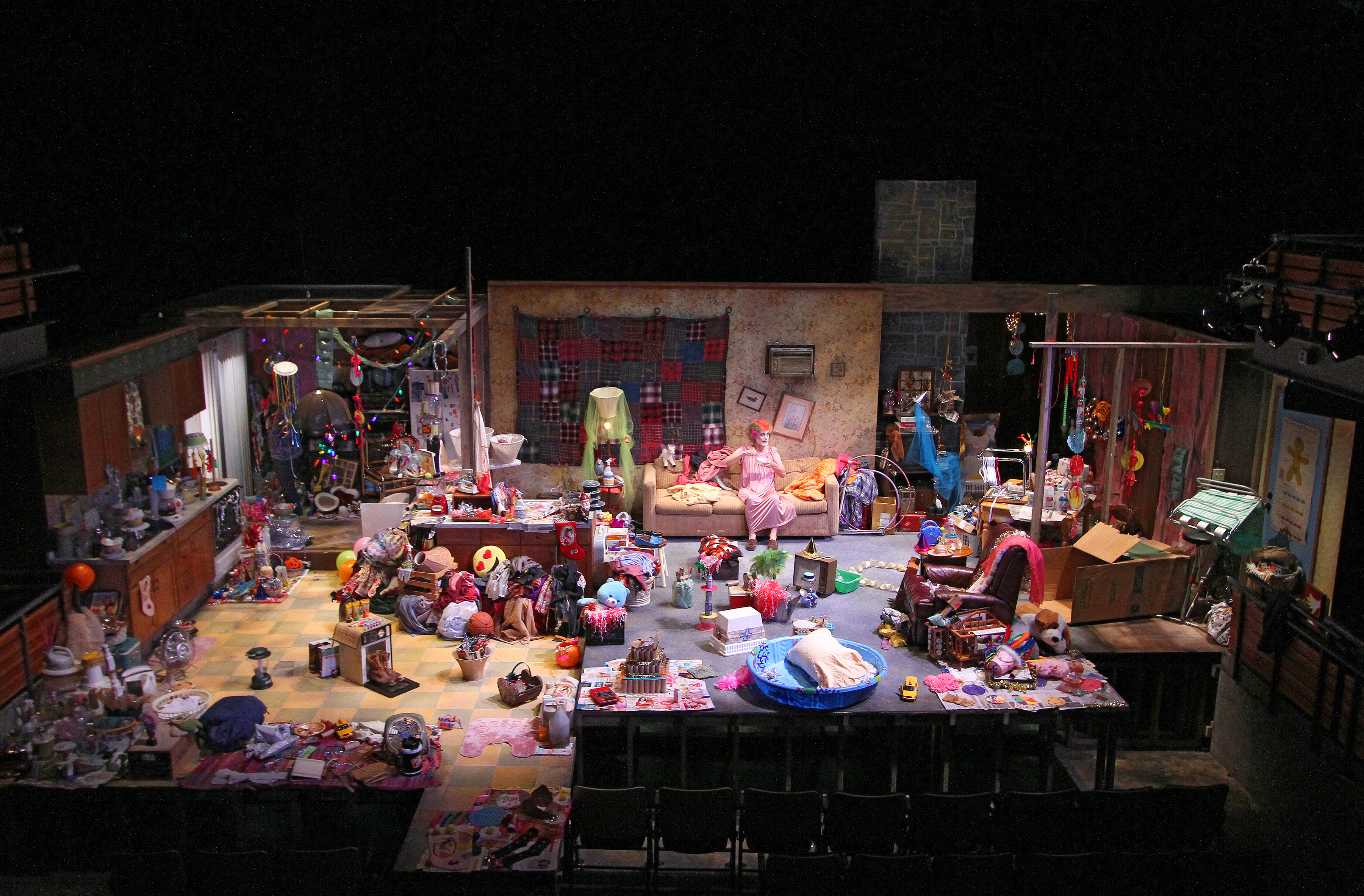
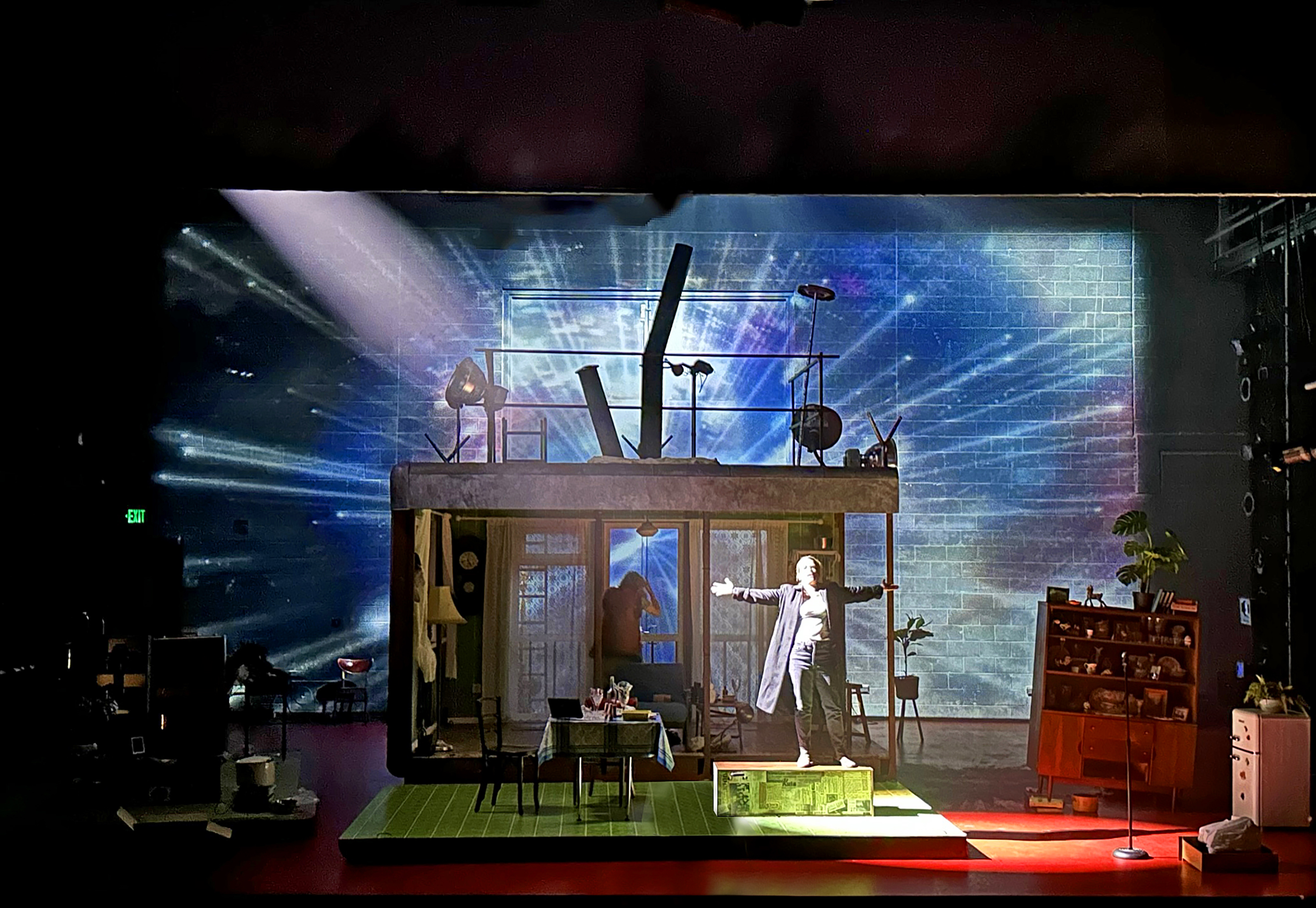
I designed the world premiere of Aaron Posner’s Stupid Fucking Bird at Woolly Mammoth in 2013. SFB, a Woolly commission which consequently became one of most produced recent American plays, was directed by my friend and mentor Howard Shalwitz, Woolly’s founding artistic director. (I am a Woolly Company Member) The original script (which, I must admit, I had strongly detested on taste grounds) consisted of ten or twelve individual scenes. I vividly remember how we were workshopping the play when I said that episode 4 and the subsequent 2 scenes feel like they are taking place in a kitchen in a middle of the night, with people in nightdresses and pajamas wondering in in search of snacks and drinks and opening a fridge to stare into its lit interior. Thus, the second 1/3 of the show had to take place in that kitchen — which was a hyper realistic set depicting a kitchen in a converted farmhouse, complete with working appliances, running water etc., which was a sendoff to a long, proud and parochially annoying tradition of American theatrical ‘realism’. Lo and behold, the subsequent Samuel French edition of Stupid Fucking Bird defines it as a play in 3 acts, with stage directions at the top of act 2 describing the setting as a kitchen in a converted farmhouse. I take perverse in the fact that Misha’s kitchen had been literally written into the final version of the script.

A Summer Day, source: Misha Kachman

3. What is your creative process—do you follow a routine or does inspiration come spontaneously?

I reckon I don’t have a structured and defined ‘process’ to speak of — much to the frustration of my graduate students who expect to be exposed to an algorithm, a set of disciplined step-by-step actions that might lead them to a result. I do not do what they call ‘research’. (a word use that I find very amusing — a lot of people in my family tree and among my friends are in medicine or sciences and I reckon that ‘research’ is what they do while we simply look things up.) I sit in my studio, doodle, watch TV, walk around. I do not believe an anything remotely supernatural but, like many Russians, I am somewhat superstitious. Thus the process of looking for the right idea is emotionally reminiscent of wild mushroom hunting: one embarks on it based on their belief that the desired mushroom already grows somewhere in there, irrespective of your search, and your task is to locate and snatch it.

Beyond the initial ‘big’ idea my work is sculptural and therefore very model-based: I make a bash model which gradually becomes the finalized model as a replace individual parts and get more specific.
I have no preconceived notion of what my tools should be when I embark on a project. I get concerned when someone, while meaning to make a compliment, tells me that they have seen a design which ‘looks like Misha’s work’. This freaks me out as I try to figure out, in a panicky way, whether there’s some kind of a recognizable ‘Misha’ move or gesture that has given me away

Akira Kurosawa Explains His Films and Yoghurt, source: Misha Kachman

4. What has been your biggest challenge as an artist and how did it influence your growth?

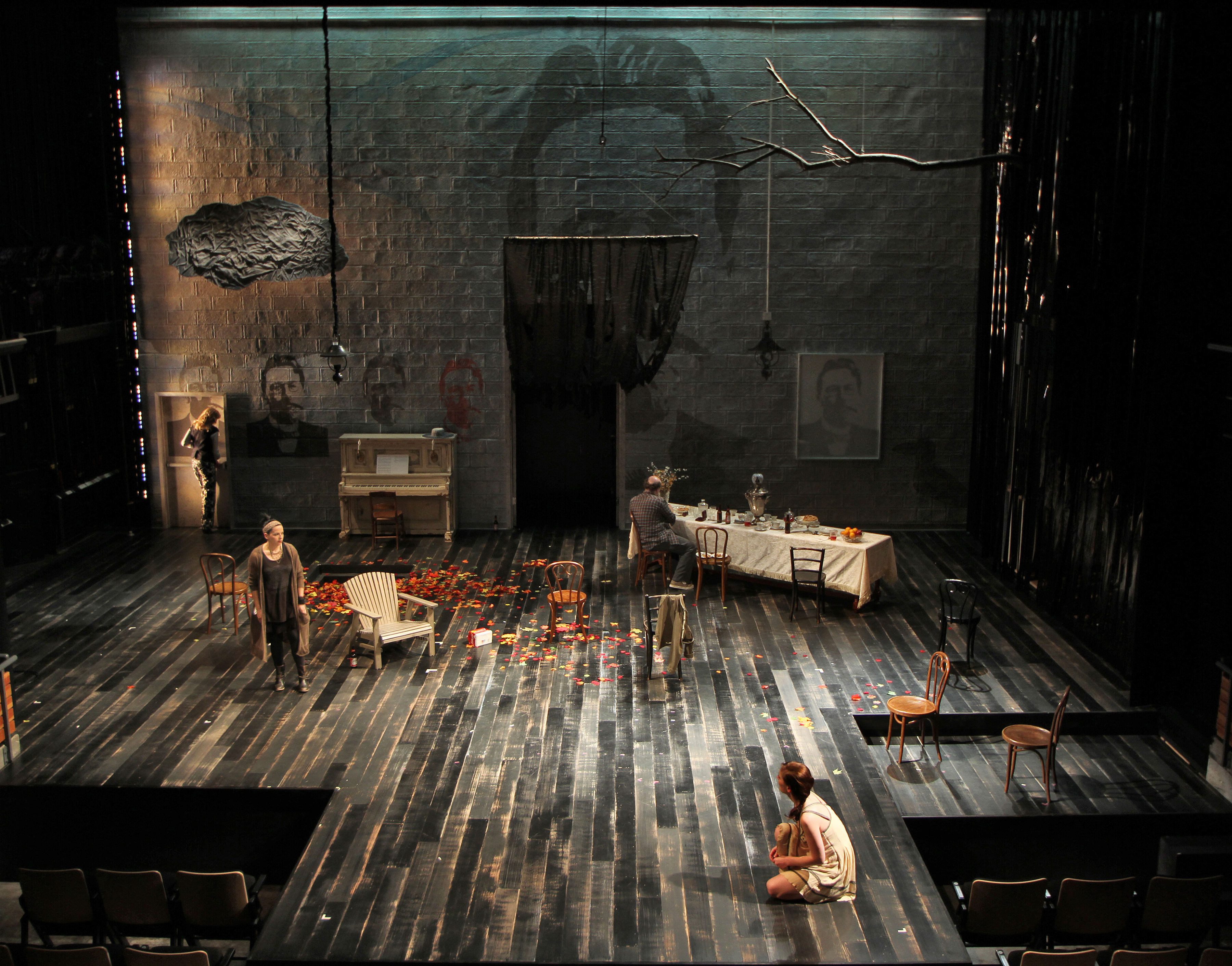
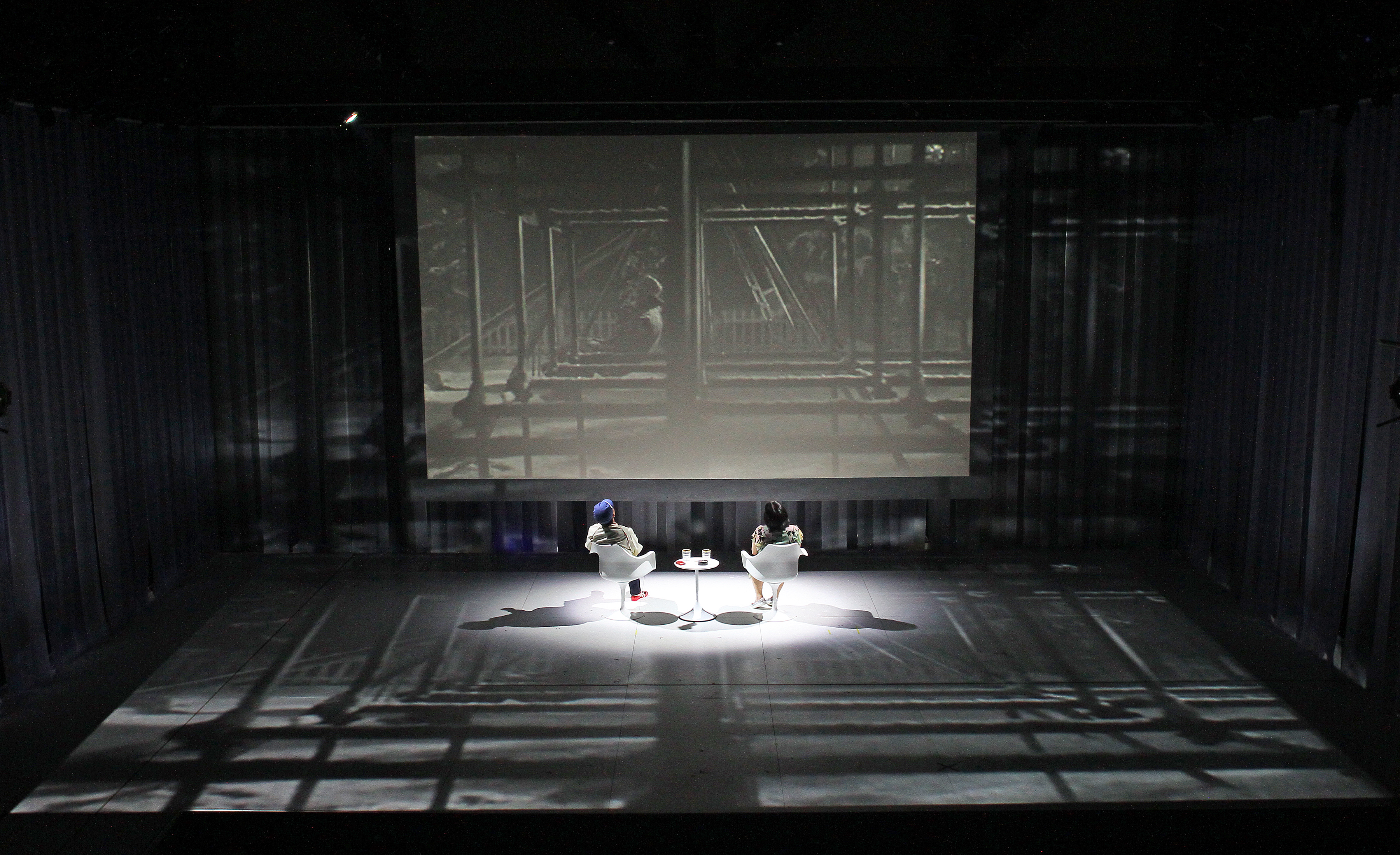
I wouldn’t call it a challenge but rather a conundrum. Our art form is interpretive, and we deal mostly with written texts (e.g. plays), right? The question that puzzles me when I embark on a project or when I watch someone else’s work is this: why have we/they bothered to produce this? What is the added value beyond words on the page? How is what we/they have come up with more alluring than having a group of good actors sit onstage in front of music stands and just read the script out loud? Particularly if it is a play that has a long production history… Better be some interpretation that addresses those concerns convincingly. The true challenge is to tell the audience something they don’t already know and not to allow yourself to slip into visual language commonly associated with that script in particular. (or with ‘that sort of a script’) I can easily renumerate what I would call various ‘design kits’ — the Chekhov/Ibsen/Our Town kit (bentwoods, floorboards, planking, fall leaves etc.), the Shakespeare tragedy/chronicle kit (rough cut wooden beams, rusty metal, haze, Matrix-like costume silhouettes, side light…), the cool modern play, (a white box set, live feed video, practical florescents, LEDs) so on and so forth. I can keep going.

Marie Antoinette, source: Misha Kachman

5. Who or what inspires you the most, and how is that reflected in your work?

What impresses me is when I encounter beautiful work and can’t comprehend how this work has come about. This does not happen to me very often (I admit I am a snob but snobbery, according to late Joseph Brodsky, is a form of despair) but I’m truly moved when I don’t understand the mechanism, the moving gears, the algorithm that has led THEM to do THIS. It leaves me feeling both helpless and in awe. It is the incomprehensibility of the process behind the piece that is so impactful— because my body simply doesn’t make whatever chemicals have enabled THEM to come up with what I am watching. If I know how the sausage is made, I lose interest. I can’t articulate how this inspiration shows up in my work, this might be something for others to judge.

6. What do you think is the most exciting thing happening in your field right now?

When it comes to both scenography and directing the most interesting things are happening in opera. The majority of the rest of the American live performance community seem to live in fear of interesting choices. Opera people, on the other hand, appear to be more willing to allow creators to go out on a limb and take risks as opposed to, at best, to keep giving a good name to conventionality.

My Mama and the Full-Scale Invasion, source: Misha Kachman

7. What advice would you give to artists or creatives who are just starting out?

Sorry but I don’t have one piece of advice but several.

First, any art form is rooted in craft and learning the craft takes time, application and rigor. One can’t simply upload mechanical, intellectual and emotional skills required to be a successful scenographer onto oneself. It takes time and a lot of work.

Second, it is critically important to develop an ability to judge the quality of your own artwork objectively. All you will hear from others is compliments which serve no purpose. What separates a professional from an amateur is the capacity to soberly evaluate themselves. Unlike a professional, a dilletante (and dilletantes can be massively talented!) is always inordinately fond of everything they do.

Third, question the notion of what the limits of your chosen art form are. I use light as a metaphor when I try to explain this to my grad students: visual light is only a small sliver on the electromagnetic spectrum but that’s all we are aware of, even though the scale keeps continuing infinitely into both directions. The purpose of our craft is not to just figure out where to put the couch onstage, even though the job description sometimes calls for that; the real reason to be in this line of work is to try to advance our art form.

Venus in Fur, source: Misha Kachman

8. How do you hope your work will connect with people or leave an impact?

I honestly don’t know the answer to this. Painting is another matter altogether but, when it comes to theatre, we are in a kind of a service industry and the desired impact really depends on a specific project… It’s a bit of an imposter syndrome but I’m still surprised and somewhat embarrassed by how seriously people take what my collaborators and I do.

Support artists—share this

More like this, twice a month.

Off-Book is the Skene newsletter for artists and makers. Profiles, opportunities, and editorials, free. New subscribers also receive the 2026 Performing Arts Survival Guide.

About the Author

Leave a Reply

Your email address will not be published. Required fields are marked *

Abingdon Theatre Company - Season 34

RELATED POSTS.

FREE FOR ARTISTS

Get the 2026 Performing Arts Survival Guide.

Practical career guidance for performing arts artists and makers. Take it with you.