
Latest posts.

Victor Zapatero: Light Holds Memory.

Meet Mexican lighting designer Victor Zapatero, whose work blends observation, emotion, and creative intention. Discover his artistic philosophy.

Get Featured or Publish with Skene!

Raffi Feghali: From Hakawati to the Future of Theatre.

source: raffifeghali.com

Raffi Feghali is an artist who refuses to be confined by a single definition. Director, performer, improviser, storyteller, pacebuilder and fellow blogger, his work moves fluidly across disciplines, driven by an insatiable curiosity and a deep commitment to storytelling in all its forms. His artistic journey began with a childhood fascination for the unseen world behind the curtain, and over the years, that curiosity has evolved into a career that seamlessly blends improvisation, performance, and traditional Arab hakawati storytelling.

Feghali’s approach to art is both rigorous and intuitive. He sees creativity as a craft to be sharpened, a process rooted in discipline rather than fleeting inspiration. Yet his work is also deeply spontaneous, shaped by the unexpected moments that emerge in live performance. His passion extends beyond the stage—his writing, includes reflections on art, culture, and identity.

In this edition of PROFILES, Feghali shares his thoughts on breaking artistic boundaries, the evolving landscape of theater, and why he still wrestles with what it truly means to be an artist.

advertising
partner content

Raffi Feghali

he/him
Director & Actor
Lebanon
source: Evelina Pentcheva

1. What sparked your interest as an artist and how has that spark evolved over time?

At school, every day, the whole school gathered in an auditorium for 15 – 20 minutes after the first break. This was a time for general announcements by the administration, sometimes guests would visit and talk to us, a lot of preaching was involved, and the likes. And every Friday, a different class would have to present a short play to the rest of the school.

And ever since the first time I entered that auditorium and I had these questions about that space that was elevated more than the rest of the hall, those ugly orange curtains at the very back. What could be behind them. Why those places exist in the first place. I then volunteered to handle the technical requirements of those sessions to get closer access to that magical space I was so curious about.

And the rest is… well, an ongoing story.

2. Can you share the story behind one of your favorite works and what it means to you?

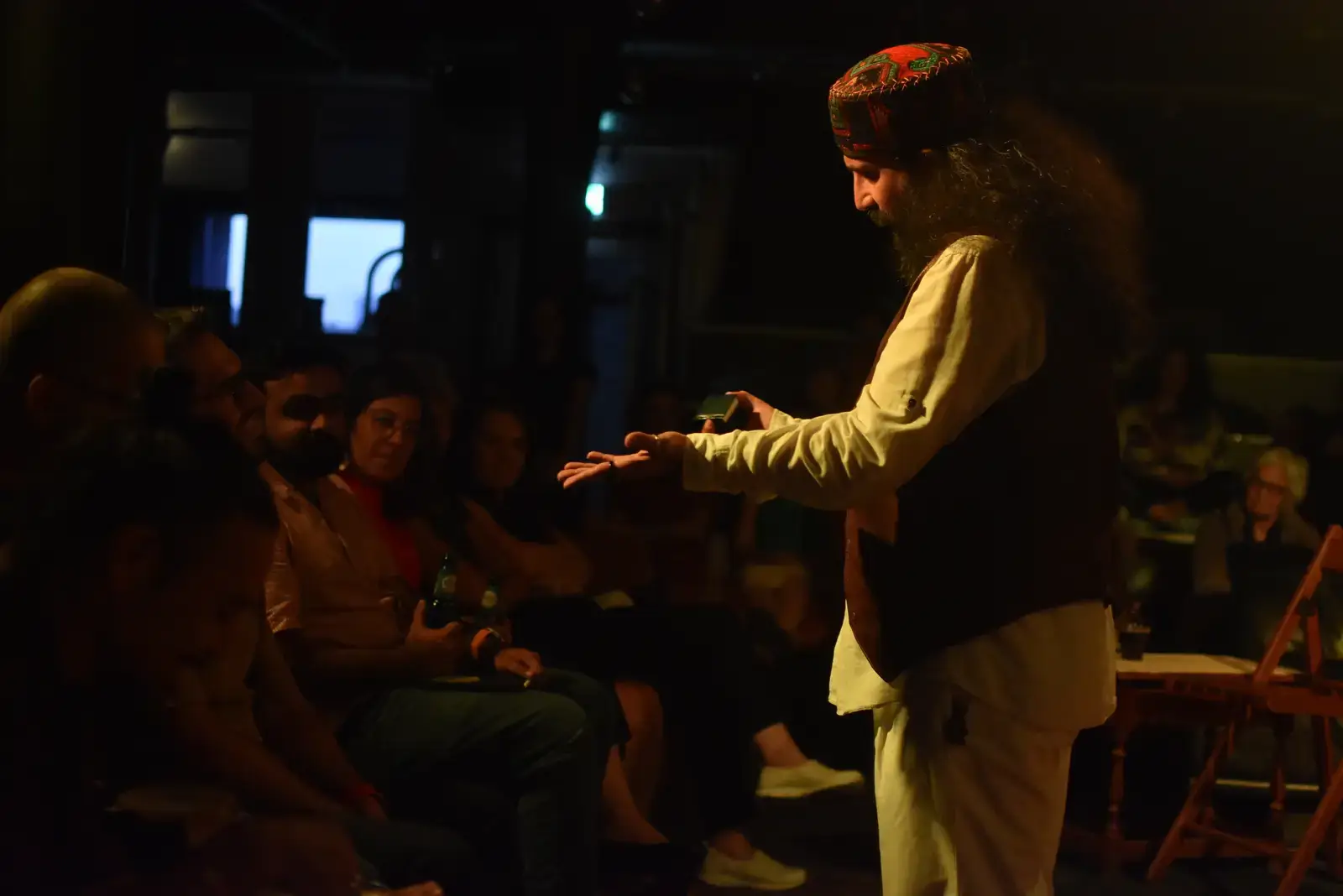
I am very lucky that my life in the theater has been very rich. It’s been diverse with different genres and different skill sets. I work in comedies and dramas. I act and direct and design the sounds and music. I improvise. I clown. I am a storyteller (not in the way this word is being used for everything now. More like an actual storyteller, rooted in the traditional Arab hakawati tradition). And I love that. I am not a fan of the saying “Jack of all trades, master of none”. I love how all those crafts come together to enrich each other and to make me who I am as an artist. And for a very long time, I’ve always wanted to be in a show in which I utilize all the different parts of my artistic identity. And for some reason, it’s always been very difficult to find such an opportunity. Until a couple of years ago. I started a collaboration with Stephen Kearin to direct my solo improv show. And low and behold my dream of so long has come to life. In Halim Al-Hakawati I embody the character of Halim, a storyteller who tours with his musician, Kareem, and lights operator, Saeed, to tell stories. More about the show here, if you’re curious, but it is in this show that I find myself able to be comfortable in my full artistic identity. I play a character that has fixed characteristics and that keeps evolving. I improvise. I tell stories. I interact with the audience. I am still waiting to play some music, but I’m sure that day will come.

3. What is your creative process—do you follow a routine or does inspiration come spontaneously?

I am a firm believer that the creative process is a craft. I think anyone can learn it, as long as they’re passionate enough about it to keep the drive and momentum going. From that perspective, I approach my craft with the mentality of expanding my tool set. At the same time, I’m always building the skills required to use those tools. Even though there are bouts of inspiration here and there, I think they come only because of the crafts-based process. I am also a big fan of rituals. Rituals that help us enter “the third space” and rituals that help us smoothly exit. Thus, I attend to my work whenever I need to, through such rituals, and I make sure I give myself enough time for breaks so that things keep working in the background. I think those bouts of inspiration are “semi-finished work” that was happening in the background. I make sure to be ready for them.

source: raffifeghali.com

4. What has been your biggest challenge as an artist and how did it influence your growth?

My biggest challenge as an artist has been the inferiority complex of never having “studied” my craft academically. Don’t get me wrong. I am a firm believer that arts are and should be learned, but we should do so by “getting our hands dirty” and not necessarily by studying them academically. Of course, I see the value of studying them academically, but I don’t believe that you need to take that path to become an artist. However, and probably because of my upbringing or the society I grew up with, this belief stays at a cognitive level and it keeps coming back from time to time when it comes to the visceral level. Even though it’s not the best feeling in the world, it has also contributed to my ongoing “education” in my craft. I feel that I’ll always be a learner. Even though I’ve been living off of my art for about 20 years now, I still feel I have a long way to go to become an artist. This is difficult, I agree, but it’s also what keeps me fresh and open to new things.

5. Who or what inspires you the most, and how is that reflected in your work?

Even though there are tons of artists who have inspired me throughout my life, I now find inspiration more and more in everyday life. Telling stories of people who are not famous or “great” or inventors or anything like that is what’s been driving me recently. Every details of life around me, whether parks, museums, engineers, waiters, products,… and their interactions is fascinating to me. I think we are at a time in the history of mankind in which all of these interactions are being redefined. Being around that is inspiring. In my work, I try to tell these stories. I try to recreate them from narratives that make them look as great as the next invention.

6. What do you think is the most exciting thing happening in your field right now?

Oh wow! Everything! I’m in a constant state of amazement at what is happening in my field right now. I don’t think theater or music have ever been more accessible than now. This access, even though it creates an excess of work that is not great, the 5% of great things created are being done by people who in other eras would have never dreamt to even try. Artificial intelligence is starting to remove all the technical aspects of the work that slow things down so that artists can focus on the core of the work. Representation is better and great work is starting to appear from anywhere and by anyone. I’ll stop at these or else I’ll take the whole issue to express my excitement. I believe this is the best time to be alive and doing what I do, even though some people could easily argue the opposite as well.

source: Alborz Sahebdivani

7. What advice would you give to artists or creatives who are just starting out?

I learned very late in my life that “professional” is not a level or attribute. For a long time, I used to think that if something is professional it means it’s well made and of great quality. Now, I understand that professional only means something you make a living from. I don’t know what exactly aspiring artists or creatives can do with this piece of information, but it did change a lot of things for me when I realized it. I think something along the lines of “Don’t let whether you make a living out of something or not decide whether it’s your craft or not.” Or something like that.

8. How do you hope your work will connect with people or leave an impact?

I believe that the arts are an integral part of culture and culture is an integral part of our individual and collective identities. Cultures influence a lot of the decisions we make. So if my work resonates with someone, provides an excuse for reflection, or shows someone a different perspective on things, then that would be among some of my dream impacts I’d like to leave on the community.

source: Yara Abi Nader

Support artists—share this

More like this, twice a month.

Off-Book is the Skene newsletter for artists and makers. Profiles, opportunities, and editorials, free. New subscribers also receive the 2026 Performing Arts Survival Guide.

About the Author

Leave a Reply

Your email address will not be published. Required fields are marked *

Abingdon Theatre Company - Season 34

Related Posts

FREE FOR ARTISTS

The 2026 Performing Arts Survival Guide.

Practical career guidance for performing arts artists and makers. Take it with you.