




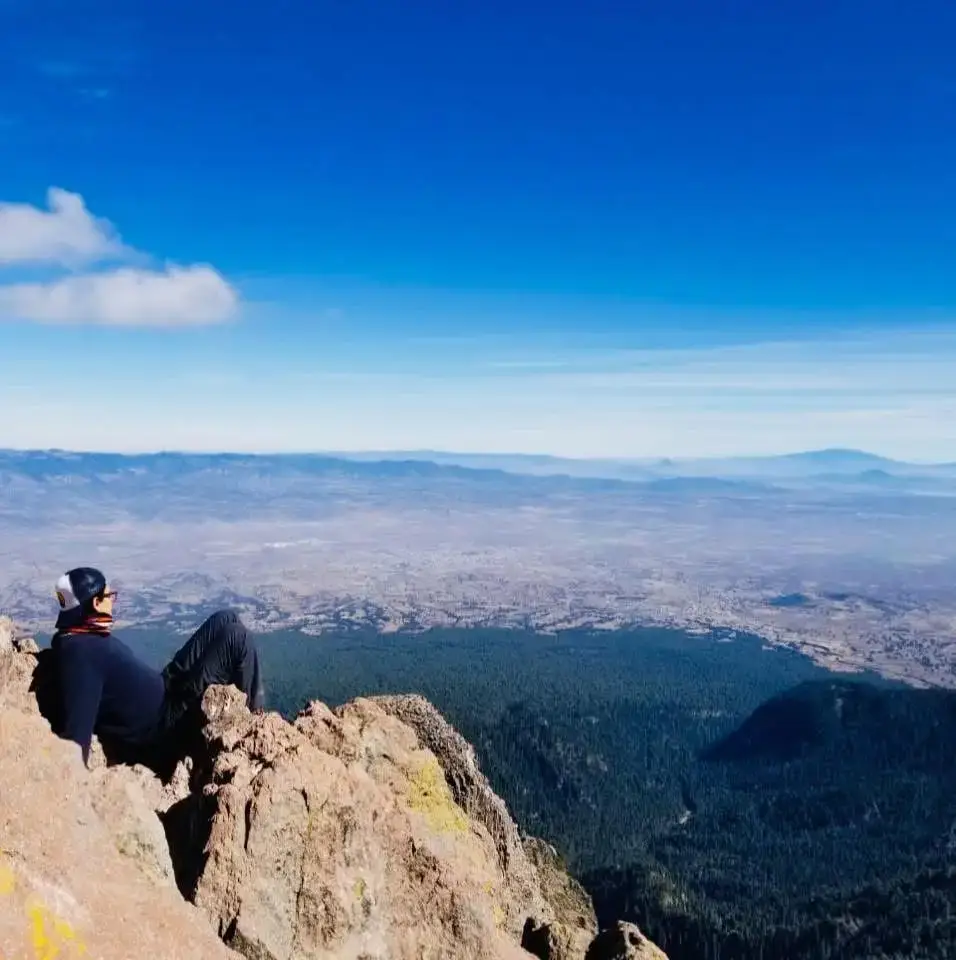
by @mosquedaroberto
This column is a Staff translation. The original column in Spanish can be found here.
This year, I turn 40. Statistically, that’s half a human lifetime, and I’m already feeling the infamous “midlife crisis.” I started 2025 by asking myself an uncomfortable question: “Roberto, have you been successful?” Oof.
Today, success is tied to wealth, power, and physical beauty (but really, when hasn’t it been?). According to the Royal Spanish Academy, success is defined as the “favorable outcome of a business or action” or the “good acceptance of someone or something.” It’s synonymous with triumph and victory, closely linked to fortune, fame, and prestige, among other things.
That definition contrasts sharply with the reality that, in Mexico, 74 out of every 100 people born into the lowest socioeconomic group remain there for life, unable to rise above poverty, according to federal government statistics. It also clashes with the fact that the wealthiest 1% of the world’s population holds more wealth than 95% of humanity combined.
And let’s not even get started on physical beauty in a world shaped by lookism and racism. I suppose just “trying hard” isn’t enough, despite what certain influencers and manifestation gurus might want us to believe.
The paradox is that we—people—are the ones fueling this concept of “success,” built upon our needs, desires, and, in the best (and most privileged) of cases, our advantages. So, as I continue my questions for the year: Does this aspirational idea even fit within a social order that is so absurdly unequal?
On top of that, there’s a new factor that humanity has never faced before: the massive interconnectivity of social media. More than 60% of the world’s population has internet access, and of those users, 92.3% use social media.
While these platforms offer an unprecedented opportunity for communication, the problem is that they are deliberately designed to be addictive, to keep users staring at their screens for as long as possible, and to generate capital. They aggressively promote and spread unattainable lifestyles. Within this frantic dynamic, many people—obsessed with instant gratification—end up basing their self-worth on what they see and the number of “likes” they receive.
So, back to my question: “Roberto, have you been successful?” I’m an actor, dancer, and theatre creator. I’ve done hundreds of auditions and never landed a commercial or a role in a series. I haven’t had even a supporting role in a national film production. I don’t have millions of followers, and none of this is something I can boast about or monetize on social media. I’m not famous on a massive scale, nor am I wealthy. I don’t own a house or a car, and I don’t have six-pack abs to pose in a tiny swimsuit. I mean, I’m not Luis Gerardo Méndez, much less Timothée Chalamet! (With all due respect to them and their careers.)
It’s easy to get caught in the web of comparisons, frustrations, and meaninglessness. Recently, the University of Utah’s Department of Health found that among U.S. teenagers who reported having suicidal thoughts, 6% attributed them to Instagram. This especially affects those of us in the arts, as our work is directly tied to the approval of an audience shaped by the marketing and entertainment industries.

What a picture! So, I scroll back up and reread the definition of success: “favorable outcome,” “good acceptance.” I do a personal exercise—I list what I do have, what I’ve built on a personal, professional, and spiritual level. And as I take in those treasures, I remember something:
In 2019, I created and premiered Flores para los Muertos, a physical theatre and dance monologue about a man who, fleeing a violent reckoning, crashes in the mountains and arrives at Yolizyeyantli, “the place of life”—a mystical space where he realizes he has actually died. There, his soul must choose between forgiving, forgiving himself, or being lost forever.
This piece means the world to me. It pushed me to expand my physical and vocal language because there was nothing on stage but the actor. The brilliant Paola Arenas produced it and designed a lighting scheme that brought the piece to life, creating an entire visual cosmos. Carmen Vélez, our assistant, provided a kind of… spiritual guidance, for lack of a better word. And our incredible creative team contributed deeply to the project and to me.
Flores para los muertos had a stable run and broke box office records at the María Grever Theatre in León, Guanajuato. It took us to the Cervantino International Festival and on tour through northern Mexico with the Monologues: Theatre in One Voice Festival. And after performing it at a state theatre showcase, I had a long conversation with Luz Emilia Aguilar Zinser—one of the judges—which ultimately inspired me to move to Mexico City.
But perhaps the most significant moment happened when, thanks to Paola Arenas, we brought the show to Federal Social Rehabilitation Center (CEFERESO) No. 12 in Ocampo, Guanajuato, where we performed for people deprived of their liberty (PDL). I will never forget that day. Many powerful things happened. I’ll describe just one.
After the show, we opened the floor for comments. There was a nervous silence in the auditorium. A few PDL members worked up the courage to share their thoughts publicly. Afterward, as they were leaving, several others approached me in private. The last one—a young man—told me: “I’m sorry. I know I should’ve stood up and applauded at the end, but I didn’t know what was happening to me. I just felt like crying.” Then, he shared that the play had reminded him that he needed to forgive himself.
That moment marked me. What was his story? What were the stories of his fellow inmates? What had their life journeys been? I don’t know. And I feel small just thinking about it. That day, I was the student, and I am deeply grateful for it.

Among the lessons I took from that experience was the need to value where I am and remember why I do what I do. I forget that all too often. There are days when I want to throw it all away, do something else, when I feel like I don’t have the right kind of appeal or that my craft hasn’t given me the money or power I’m “supposed” to have.
So I hold onto moments like that one. And I reaffirm that my work has had meaning, impact, and acceptance—beyond the typical notions of success. Damn! We made it to a place like CEFERESO to share something deeply transcendent with the PDL community. As far as I know, neither Luis Gerardo Méndez nor Timothée Chalamet has made it to Ocampo, Guanajuato in that way. And that’s fine! That’s what we were there for.
Let’s hold onto our life stories and fundamental achievements. Many studies show that happiness is found in meaningful relationships, having a sense of purpose, and making a positive impact on the world—not in power, money, or physical beauty.
Flores para los muertos was born from a personal story. We lost a family member to violent crime. At his funeral, two questions formed in my mind: “What led you to do what you did? If you could speak to us now, what would you say?” That’s where it all started. I don’t think I’ve ever shared that before.

I sincerely hope that, for those involved, the play gave them something good. For me, it brought poetic growth, experience, deep confrontation with my own demons, and the power to heal through fiction. Three years after our last performance, I’m only just beginning to understand that. And while we didn’t make millions, the project was mostly fairly compensated. Maybe that’s why I’ve been remembering it so fondly this year, with all its virtues and flaws.
Of course, just “thinking positively” about our achievements isn’t enough when making a living in theatre in Mexico means battling job insecurity. Or when, in general, the world can be deeply unfair, violent, and discouraging.
Humanity desperately needs deep, structural change (but then again, when hasn’t it?). Perhaps dismantling our idea of “success” on a personal, conscious, almost therapeutic level is a start.
Of course, letting go of it takes a lot of work and requires balancing the internal contradictions we all carry—without exception. Committing to honoring our own achievements also means opening ourselves up to hearing and being moved by the stories of those whose wealth is far greater than power, money, or beauty: wisdom, talent, discipline, empathy, or compassion, for example.
Perhaps if we were more mindful of the “likes” we give on social media, we would actually be helping to ensure that the social structure grants these individuals a fairer, more dignified, and better-rewarded place.
So, Roberto, have you been successful?
Creo que sí
And I think you, reading this, have been too.
Dedicated to every person who was part of the journey of Flores para los muertos, in this world and in the realm of souls; to the companions at CEFERESO No. 12 in Ocampo, Guanajuato; to my family; to my friends; and to anyone who feels lost, searching for their place in life.
We will find it.
Mexico City, February 2025.
Roberto Mosqueda is a dancer, actor, and theatre-maker with over fifteen years of experience in the performing arts. His work explores movement, storytelling, and the power of live performance to connect with audiences on a deep, human level.
You can read more about his journey and artistic vision in his PROFILE feature on SKENE.




2 Responses