Latest posts.

Get Featured or Publish with Skene!

Alex Peña: Worlds of Paper and Light.

source: Nicole Stewart.

Alex Peña approaches scenic and production design as an act of world building. For him, the stage and the screen are not simply platforms for storytelling, but portals into fully realized environments where space carries emotional weight and narrative consequence. His journey began with a fascination for stepping into other realities through film, television, theatre, and themed attractions. Trained in architecture, he first explored how physical space could shape experience.

Rooted in research, sketching, collage, and model making, Alex’s process blends structure with imagination. He builds environments that feel tangible and intentional, spaces where textures, light, and atmosphere support performance and deepen audience immersion. Whether crafting a fragile paper world that mirrors childhood innocence or designing complex environments for large scale productions, his work reflects a commitment to detail and emotional resonance.

In this edition of PROFILES, Alex reflects on balancing authorship with collaboration, navigating production realities, and embracing emerging technologies that expand how audiences experience narrative.

partner content

Alex Peña

he/him
Scenic & Production Designer
Mexico
Beached, source: Alex Peña.

1. What sparked your interest as an artist and how has that spark evolved over time?

My journey as an artist started with a curiosity of stepping into other worlds and realities through film, TV, theater and themed attractions. I found compelling to witness other realities and stories when watching a show or a film, and I had the curiosity to explore how art can be a medium to create worlds and environments that don’t belong to our own, and how the characters and elements of these worlds create narratives that make captivating stories. I explored music, film and theater and over time I found my way into working in the industry through architecture. I had a big fascination with designing spaces and create experiences through the use of space. Overtime, I felt that my curiosity and fascination with spaces and design were limited and restricted by conventional architectural standards, and I embarked on a new journey to explore space through storytelling. I found this possible through production and set design, where I was able to translate my skills from architecture and apply them to theater and film. Today, I approach production and set design as world-building, creating environments that are story and narrative driven.

Waiting for Daddyot, source: Alex Peña.

2. Can you share the story behind one of your favorite works and what it means to you?

I think my favorite work is constantly changing, I fully focus and commit to the projects I’m working on at the moment. Currently, ‘Waiting for Daddyot’ is a project that I’d say is my favorite. The story follows two kids waiting at a bus stop for their father, who may or may not come. The story reflects the innate innocence and hope that children have, but also a deep existential reality where they know they’ll be waiting endlessly. The set design presents a paper-like world, that reflects the nature and curiosity of the kids, that is at the same time volatile and impermanent, meeting the reality of their endless wait. Designing this play was an opportunity to play with contrasts and create a world that feels both innocent and hopeless. Exploring the world through the kid’s perspective presented a challenge but also a great opportunity to craft an environment that feels childish, fragile and paper made. Seeing this project turn from abstract words into a physical, tangible set provided me the opportunity to keep exploring new ideas for the upcoming full length play.

Waiting for Daddyot early sketch, source: Alex Peña.

3. What is your creative process—do you follow a routine or does inspiration come spontaneously?

My creative process has evolved overtime, and it adapts to different projects, scales and needs. My process is structured and always in need of inspiration, which can come gradually or spontaneously. I enjoy studying the text and understanding the world I’m aiming to build, its characters, settings and the narratives that can impact the design. My process relies very heavily on research; sources like books, films, art, and music. I like to consider every resource to help me craft more real, tangible and complex worlds to tell a story. It is one of my first responses to draw, sketch or collage after reading the text. The research I gather is usually in line with the first images I create and I find collaging and sketching great tools to merge my drawings with the research. My process also involves having conversations with the creative teams, where I narrow down my ideas to the pieces that serve the concept better. I later test and present my ideas with physical and/or three dimensional models in order to understand the concepts better. Every part of my creative process is consequential to the next and I constantly revisit all stages to iterate new and evolved concepts to better serve the story.

Waiting for Daddyot, source: Alex Peña.

4. What has been your biggest challenge as an artist and how did it influence your growth?

My biggest challenge has been learning to balance creative authorship with collaboration and real production constraints. Working in the entertainment industry, theater and film, has taught me that strong ideas only matter if they can survive the real production constraints, like budgets, schedules and collaboration with other voices. That shift reshaped how I work today, where I’ve learnt to design with intention and flexibility and open to other collaborative voices. I’ve also learnt to team up on big productions where everyone’s work and talent creates unique and strong work. This has made me a better designer and a stronger leader, allowing me to contribute creatively while supporting a collective vision.

Beached, source: Alex Peña.

5. Who or what inspires you the most, and how is that reflected in your work?

Inspiration comes from different sources, mainly from art and environments – films, music, real places and moments where space carries emotional weight and storytelling. I find inspiration in places that have a unique atmosphere that invites to contemplate and study the space and its qualities, like the lighting, textures, decoration, sounds, among other elements. I really enjoy spaces where every element adds a layer of complexity and information to the experience of being in it. That constantly shows up in my work, where I like to make an emphasis in world-building and creating atmospheres and environments that help people step away from reality for a moment to witness a story. I like creating heavily crafted spaces with close attention to detail that can enhance an actor’s performance and invite an audience to be part of that world.

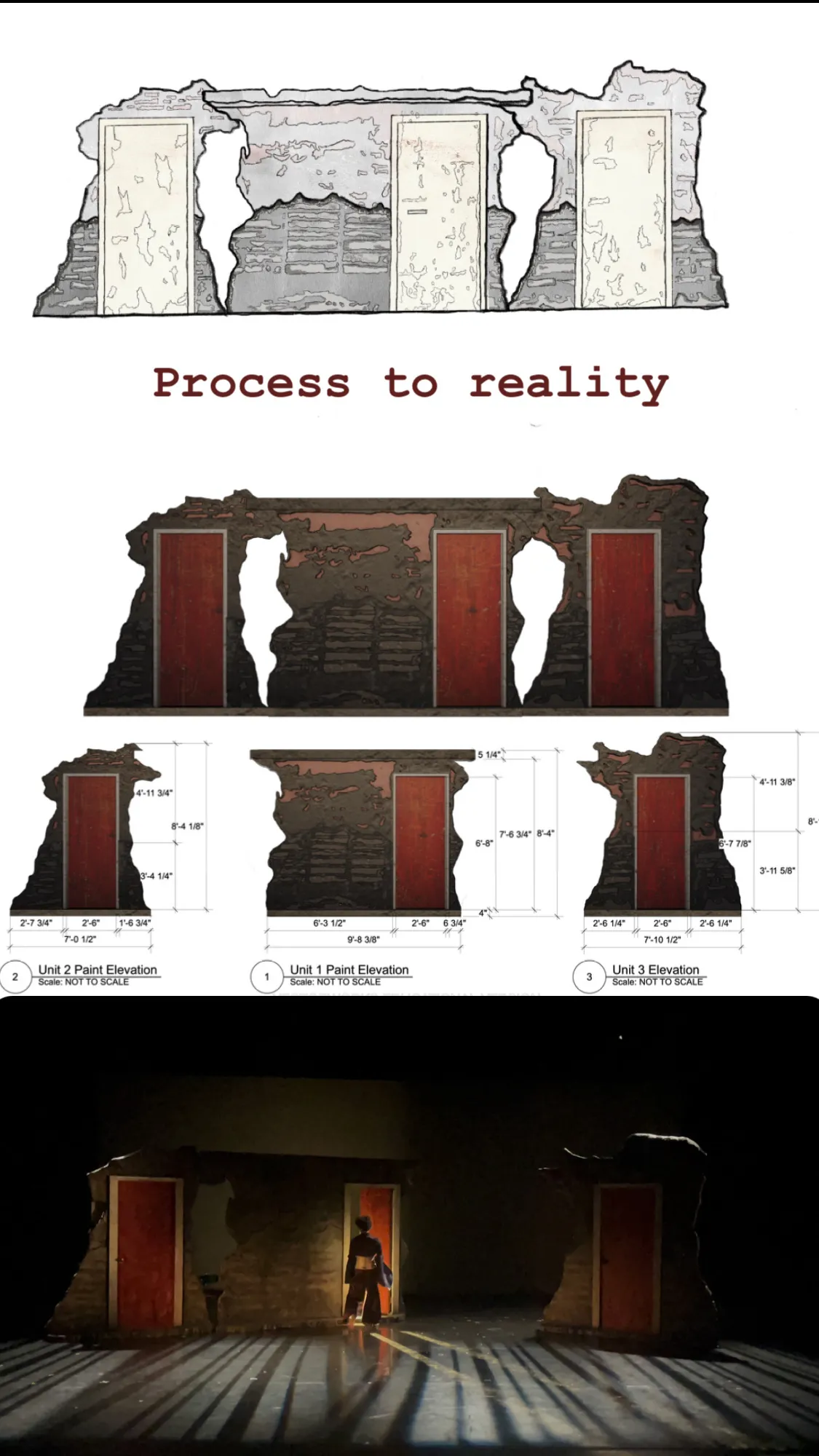
Beached paint elevations, source: Alex Peña.

6. What do you think is the most exciting thing happening in your field right now?

I think the entertainment industry is currently going through a very exciting moment, where there are new technologies being introduced to conventional ways of theater making and filmmaking. It is exciting to have new technologies as tools to enhance the audience’s experience when witnessing new worlds, as real-tangible spaces. We can see this more often in immersive experiences and theater that is getting more popular, where there’s a mix of different mediums like film, cinematography, theater and music. I find it very exciting to be able to create worlds for the stage and film, but also materialize those environments in experiences where people can literally step into other worlds and be part of it, feeling, touch and making use of their five senses to live momentarily in another reality.

Anima rendering, source: Alex Peña.

7. What advice would you give to artists or creatives who are just starting out?

An advice I would give to an aspiring artist trying to enter the theater, film and/or TV industry would be to define and establish what they want to accomplish in their career and then set up a strategy to get there. There is no one defined route to get involved in the industry, everyone has their own path, but it is definitely a competitive field where the more specialized and proficient you are at your job, the better. I would suggest to focus and master their craft and to follow and trust that line. As creatives, there’s always opportunities to pivot from one discipline to the next, and I would encourage aspiring artists to do this early in their careers to discover their purpose, but then prioritize it and become a master at their chosen craft, have your name associated with it and avoid falling in a vague category of an artist. This industry requires profound levels of specialization, and the more you focus on your craft, the better you will become, the projects and the career will naturally follow.

Chronovisor rendering, source: Alex Peña.

8. How do you hope your work will connect with people or leave an impact?

I hope my work connects with people by making them feel fully immersed in the story. My work aims to serve the story that me and my collaborators want to tell and it looks to enhance the messages behind them. I want my work to provide environments that feel intentional and emotionally grounded, in spaces that serve as containers that communicates complexity and cohesion. I also aim to create sets and environments that feel real, grounded, deeply crafted and visually impactful to audiences. I want the spaces to quietly shape atmosphere and memory, so that even after the story ends, something lingers — a mood, a tension, a sense of wonder. If my work helps deepen the emotional experience of a narrative and makes it feel more real, then I’ve left an impact.

Support artists—share this

Master Your 2026 Career.

Get our free Survival Guide for Actors, Directors, and Designers.

About the Author

Leave a Reply

Your email address will not be published. Required fields are marked *

partner content

Related Posts

Agata Uchman: Iskroma.

BACKSTAGE PASS

Master Your 2026 Career.

Get our free Survival Guide for Actors, Directors, and Designers.