Life After Graduation: Auditions, Jobs, and Building Sustainable Momentum.
Navigate life after theatre graduation with practical guidance on auditions, survival jobs, financial planning, and sustainable momentum.

Navigate life after theatre graduation with practical guidance on auditions, survival jobs, financial planning, and sustainable momentum.

Nia Safarr Banks is a costume designer whose work translates character and inner life into clothing that tells honest, human stories.

Scenic and production designer Alex Peña on world building, immersive environments, and crafting story driven spaces for stage and film.

Kendall Bas is a Filipino scenographer whose work on La Perle and beyond treats every space as a stage where story and action meet.

Josafath Reynoso PQ Symposium flash talk explores digital platforms as scenographic spaces, living archives, and sites of performance and collective memory.
Some artists discover costume design by accident; for Agata Uchman, it arrived like a language she had always known. Long before she stepped into a studio, she was building vivid worlds from her grandmother’s wardrobe, stitching tiny garments with her grandfather, and learning how fabric could conjure identity, character, and emotion. That early spark—her personal Iskroma—never dimmed. Instead, it grew into a practice defined by curiosity, experimentation, and a deep commitment to the expressive power of costume.
Today, Agata moves fluidly between theatre, wearable art, and sculptural form, shaping pieces that breathe with geometry, color, and narrative. Her influences span the Bauhaus, Polish artistic traditions, and contemporary visual culture, yet her work remains unmistakably her own: bold, intuitive, and always in motion. Whether crafting hundreds of intricate pieces for large-scale productions or developing abstract forms that push the boundaries of what costume can be, she approaches each project as both a discovery and a dialogue.
In this edition of PROFILES, we step into Agata’s world—one where costume becomes an emotional architecture, a visual rhythm, and a living conversation between maker, performer, and audience.
My artistic spark was born from a childhood filled with imagination and play — something I like to call my personal Iskroma. I grew up dreaming of becoming a costume designer. I used to dress up in my grandmother’s clothes, inventing characters and stories through whatever I could find in her wardrobe. I had eight Barbie dolls, and together with my grandfather I would sew tiny outfits for them, experimenting with fabrics, shapes, and colors long before I understood what design really was.
Drawing was another part of that early spark — it felt natural, like a language I instinctively knew how to speak. Over time, that childhood fascination matured into a deeper commitment to storytelling through costume. What started as play gradually evolved into a desire to understand how clothing shapes identity, emotion, and performance.
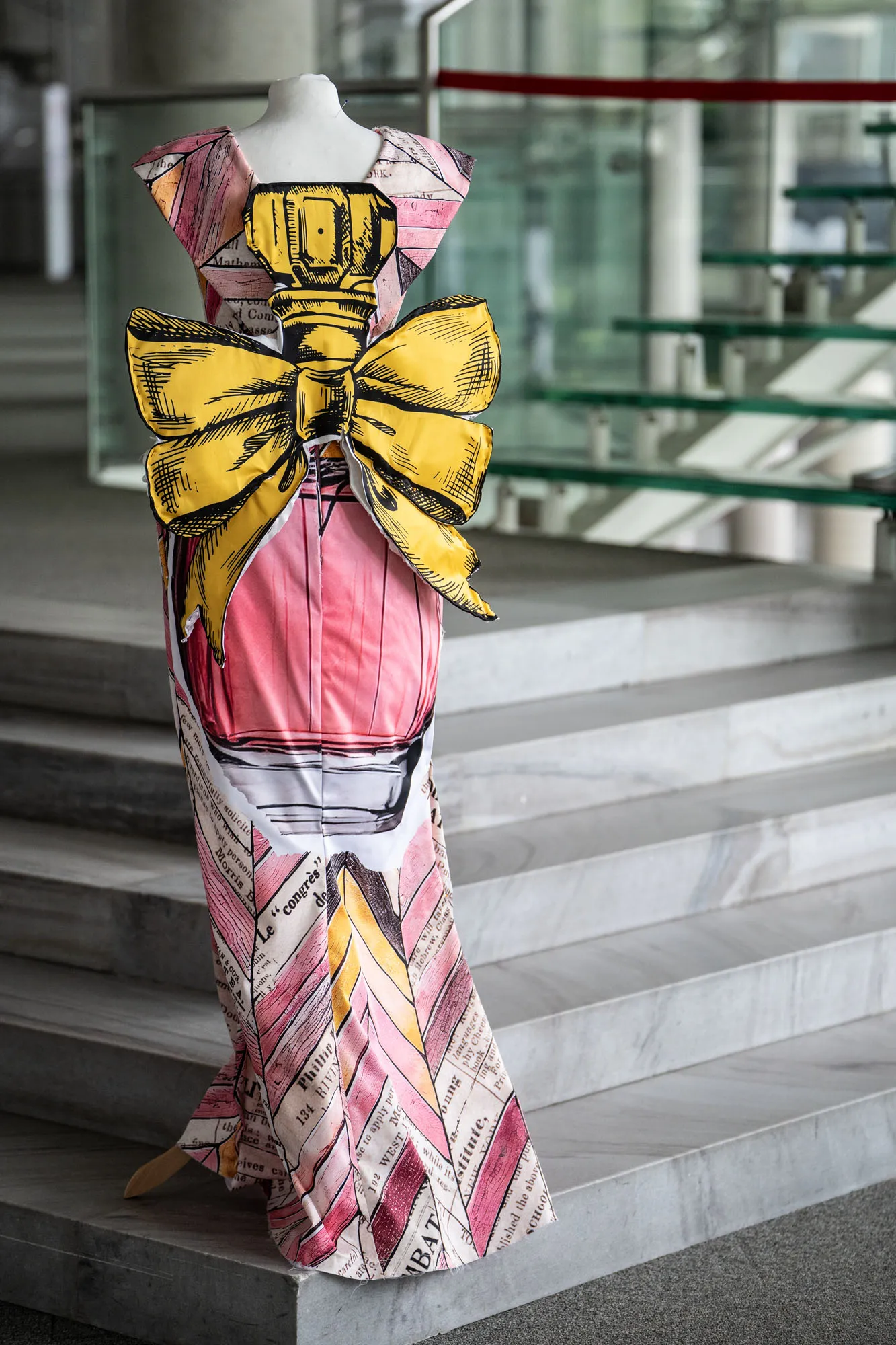
One of my most meaningful projects is my folk-triadic costume series — an individual exploration in which I merge elements of Polish folklore with the visual language of the Bauhaus. It marked an important shift in my practice: a step beyond traditional costume design toward wearable art.
This project allowed me to approach the costume as an abstract sculpture, rather than simply a functional garment. I was inspired by artists such as Sonia Delaunay and Yinka Shonibare, whose work plays with rhythm, geometry, and color in ways that resonate deeply with me. Translating those influences into three-dimensional, body-centered forms became both a challenge and a discovery.
Creating these pieces taught me how to build narratives out of structure, texture, and movement. It was my first larger experience with wearable art, and it opened up a new understanding of how costume can exist — as a hybrid form that carries heritage, emotion, and artistic experimentation all at once.
My creative process doesn’t follow a strict routine. Each project unfolds in its own rhythm, and I let that rhythm guide me. Some works require careful documentation and research, so there is a certain structure in the way I gather references, explore visual languages, and experiment with form. That part feels methodical — a deliberate process of searching, comparing, and trying things from different angles.
But inspiration itself is rarely linear. Often, unexpected elements appear spontaneously and shift the direction of the work. I love using collage as a technique, because it allows these intuitive moments to enter naturally — fragments come together, clash, or open new paths I didn’t initially anticipate.
Sometimes my process is fast and fluid; other times I need to sit with an idea for a long while before something finally clicks. There are moments when the project stays quiet for days, and then suddenly a shape, color, or texture reveals itself and everything begins to open.
For me, creativity is a balance between exploration and intuition — a space where routine provides grounding, but spontaneity keeps the work alive.
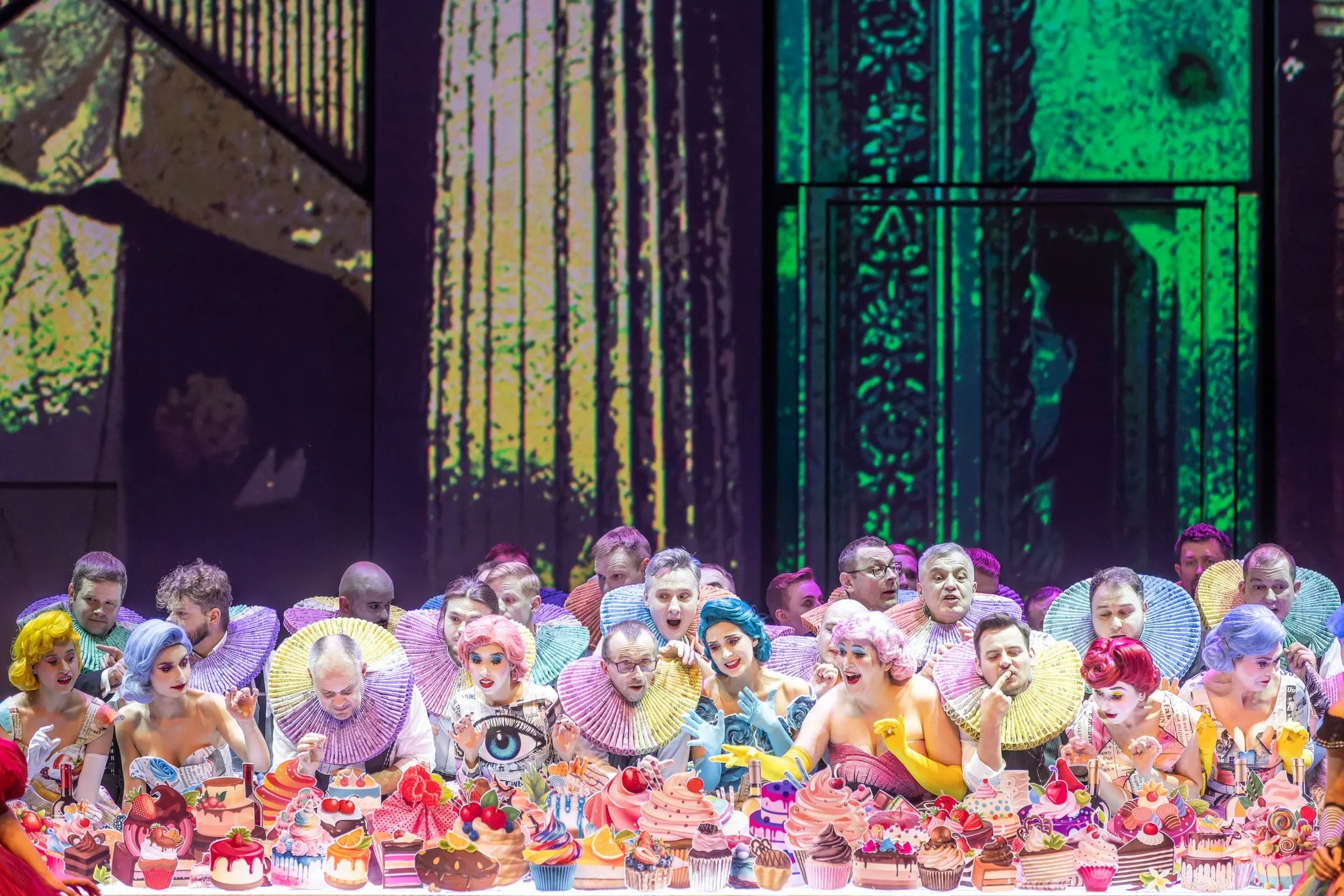
I don’t think of my journey as defined by one single challenge — many of my projects have pushed me in different ways. Large-scale productions are often the most demanding, especially when I am responsible not only for designing but also for producing the costumes. Last year, for example, I collaborated with a Broadway-affiliated company on The Pilot and The Little Prince. I had to design and produce around 300 highly complex costumes in a very short time, many of them involving sculptural and animatable forms. Managing the artistic vision while overseeing such an intense production process was an enormous test of both creativity and endurance.
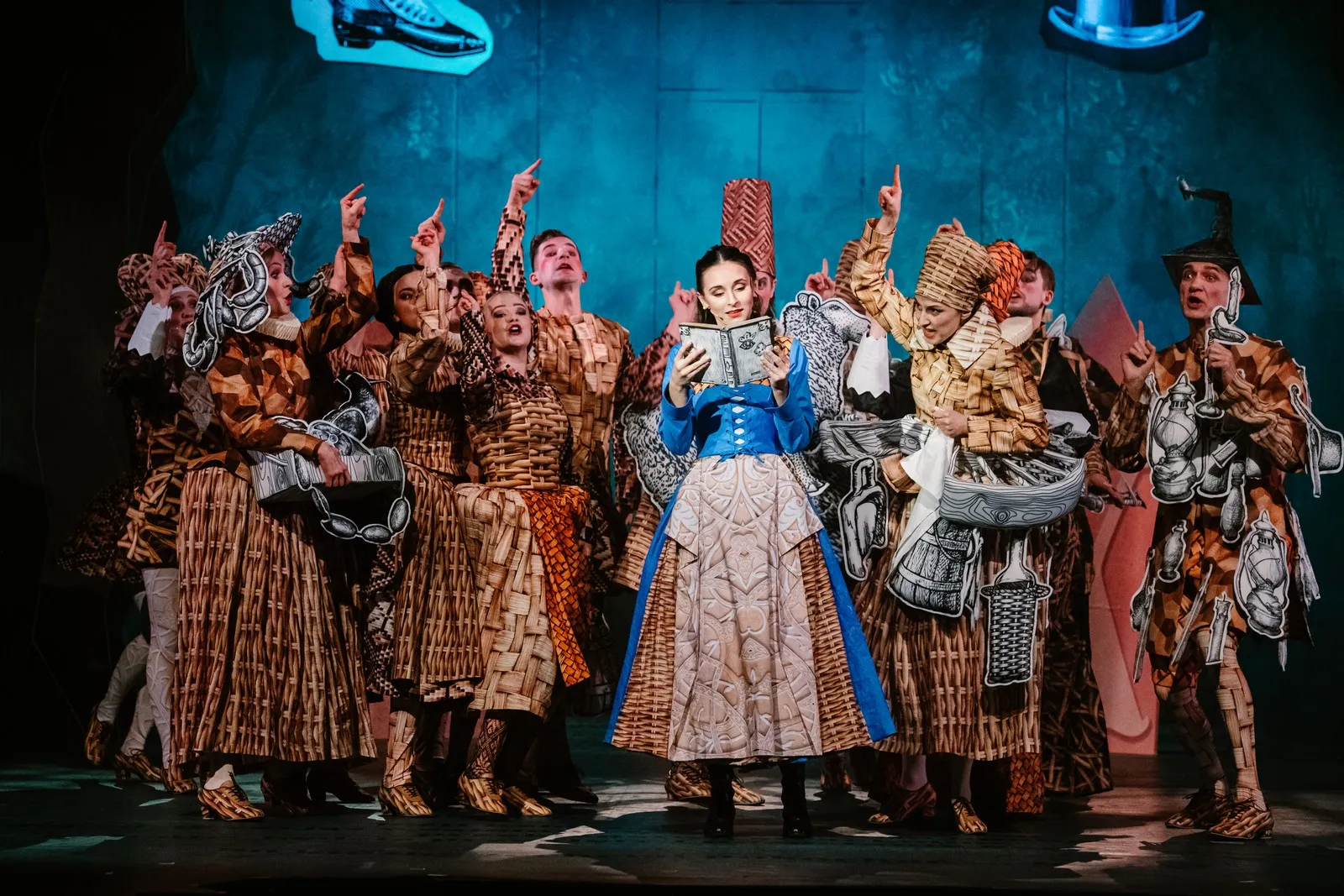
Projects that involve spatial or animational forms — like Beauty and the Beast for the Musical Theatre in Poznań — also challenge me deeply. These works require thinking beyond the body and into three-dimensional movement, mechanics, and presence.
My folk-triadic series, with its sculptural wearable art forms, has similarly pushed me to expand my technical and conceptual limits.
I draw inspiration from many different worlds, but I’m especially influenced by contemporary and avant-garde creators working with costume as an expressive medium. The legacy of the Bauhaus is deeply important to me — Oskar Schlemmer’s ballets and the sculptural, geometric approach to performance continue to shape how I think about form and movement. I’m also inspired by artists like Yinka Shonibare and Sonia Delaunay, whose bold use of color, rhythm, and abstraction resonates strongly in my work.
At the same time, I’m deeply connected to the sensibility of Polish art — the emotionality, the painterly thinking, the way artists like Jan Dobkowski approached color and atmosphere. These influences blend with my passion for fashion, photography, and fashion imagery, which offer another layer of visual language and composition that often finds its way into my costume designs.
I’m inspired by many creators and many art forms, and I don’t feel the need to narrow it to a single list. My work becomes a meeting point for these influences — a space where geometry meets sensuality, tradition meets experimentation, and costume becomes an expressive, living form.
My advice is simple: never give up, and never stop exploring. Stay open, stay curious, and allow yourself to evolve. The creative path is not linear — it shifts, expands, and sometimes surprises you completely. If you keep a fresh and open approach, both in life and in your work, you give yourself the freedom to grow beyond your own expectations.
Don’t rush to define yourself, and don’t let others define you too quickly. Exploration is part of the process; discovery happens when you give yourself permission to try, fail, shift direction, and begin again. Creativity thrives in openness.
Trust that your voice will reveal itself through continuous experimentation. Stay brave, stay playful, and let your journey unfold.
I believe that costume is a powerful tool of communication — a language in itself. Just like any form of art, it creates a direct line between the creator, the performer, and the viewer. Through costume, I can speak without using words; I can express what I feel, what I explore, and what I question.
I hope my work resonates with people by opening a space for reflection and emotional connection. A costume can reveal something hidden, highlight something unspoken, or transform what seems dark into something illuminated. It can ask questions just as much as it can offer answers. That duality is what I find most meaningful.
I want my designs to invite viewers into a dialogue — to make them sense movement, form, and intention on a deeper level. When a performer steps into a costume, the communication expands: the body animates the idea, and the audience receives not just an image, but an experience.
Support artists—share this
Get our free Survival Guide for Actors, Directors, and Designers.
We use cookies to optimize our website and our service functionalities.