Alex Vásquez Dheming: Choreographing Light.
Salvadoran lighting designer whose expressionist practice turns light into narrative, emotion, and

Salvadoran lighting designer whose expressionist practice turns light into narrative, emotion, and

Japanese costume designer and cultural advocate whose research-driven practice interrogates representation, identity,

German scenic designer whose kinetic scenography builds sets that move with the

Mexican cultural worker, director, and playwright whose practice is rooted in collective

Classic plays for community theatre: Shakespeare, Greek tragedies, Chekhov—masterpieces with zero royalties.
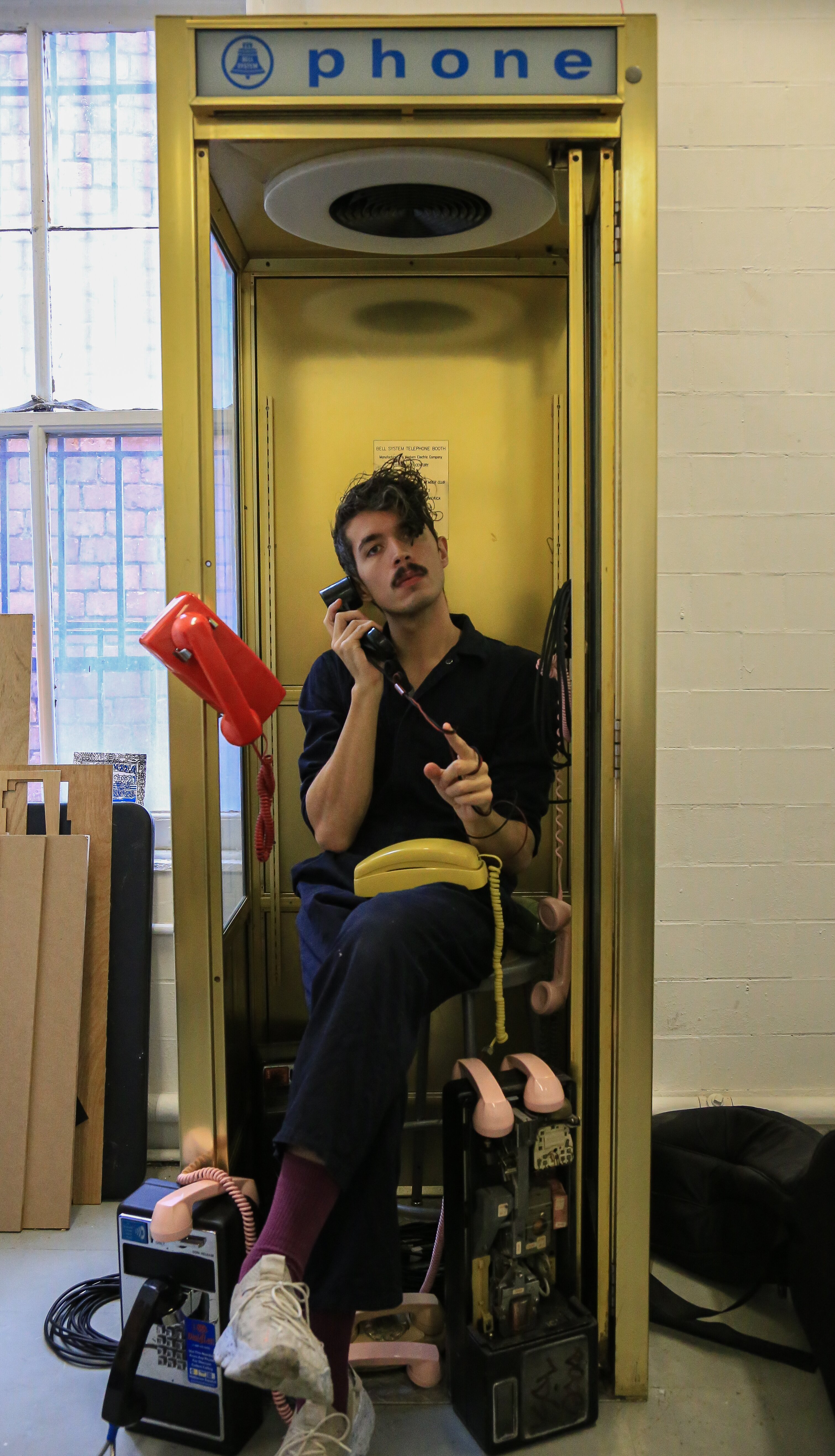
For sound artist, educator, and technologist Anthony Sertel Dean, every project begins as a conversation—one that blooms into music, memory, and connection. Drawing from electroacoustic composition, oral history, and experimental performance, Anthony creates immersive sonic environments that center community and self. Whether collaborating on a radical punk-theatre hybrid like SLAMDANCE garage or building soundscapes that carry ancestral echoes from Türkiye and the Nanticoke coastland to New York City streets, their work exists in the beautiful “in-between.”
Anthony’s practice is one of joyful entanglement—with friends, chosen family, students, and fellow artists. The result? Resonant, visceral compositions that make space for tenderness, rebellion, and play. Through every glitch, loop, or layered voice, they remind us that sound is not just heard—it’s felt.
In this edition of PROFILES, we tune into Anthony’s creative process, hear how burnout reshaped their relationship to theatre, and learn why building art within community—and with curiosity—is not only their method, but their mission.
I am very fortunate to have grown up with art, music, stories, and flowers, but the spark that led me to BE an artist must be my high school band. We were weird, nerdy teens trying to understand our relationship to love, rage, queerness, togetherness, but we did not have the words to navigate that yet. What we did have were loud screams and wails and the rich expression of these ideas through sound. Playing with my closest friends brought me to countless New York DIY venues, welcomed me into a community in which I learned to find myself, and told me that this was a special way to be in the world. And honestly, I’ve kept on playing with my friends as a way of life & art-making ever since! The core of connection and understanding through the intangible is central to my artistic practice. This can manifest as a score, a soundscape, a sculpture, a narrative, but the intention is to initiate some resonance. Hopefully that resonance leads to a conversation – internally or interpersonally – and that conversation leads to good.
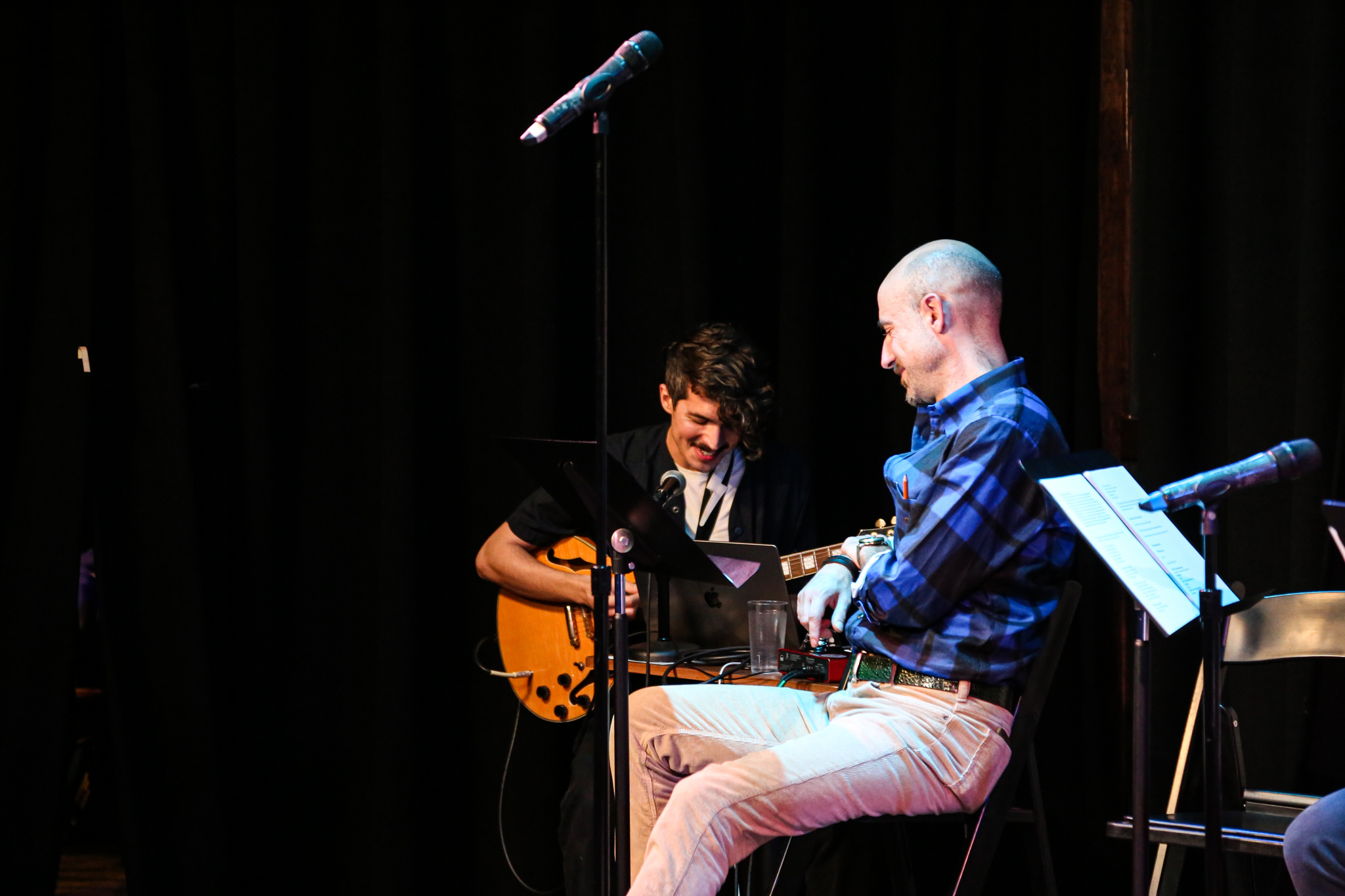
This past winter, I sound designed the radical, one-person, afropunk, community-rooted, theater-concert SLAMDANCE garage, created by Ian Andrew Askew at The Bushwick Starr. This was my ideal way to make theater. There was such mutual respect and admiration between everyone on the team, including the most genius lighting designer, Itohan Edoloyi, and the infinitely multi-faceted production designer, Cheyanne Williams (with whom I’ve been making theater since our first year of college). There were many other brilliant collaborators on the piece, and we all came together with a shared vision and message, that hit with a force both strong and comforting.
Sound designing a show that is simultaneously a loud, raging punk concert and a tender meditation on togetherness may sound counterintuitive, but that in-between-ness is exactly where Ian and I thrive. Using an array of chunky speakers and processing to immerse the room in Ian’s music – paired with some of my own constructed soundscapes/punctuations – physicalized the experience for all who joined us at the show. We got to stretch what sound design for theater can be, challenge what kinds of stories a concert can tell, and let everyone GET LOUD.
My creative process is rooted in PLAY – I guess that’s why I can’t get away from theater as a field. When I set out to make something, I often have some sort of plan, but the way to get there is often lined with scraps of attempts that weren’t quite right. I celebrate those scraps and go at it again! There is so much I am grateful for about my education and the great teachers/mentors I’ve had, but I learned many of my most-used skills/tools through simple trial and error. The only way I was taught “the proper methodology” to working in most fields was to trust my ears, hear when I was wrong, and learn to adapt. This also allowed me to free myself from a singular “proper” way of working. My creative process is probably unlike any other sound artist, since I am able to meld my practices from theater, film, music, and visual art through an unexpected route, ending up at a particularly colorful composition – still clinging to some scraps that got us there.
Burnout. That’s not a unique answer, but it’s true. Working dedicatedly, tirelessly, and emotionally on dozens of theater productions back-to-back, within systems that did not provide the necessary structures for the people working on the productions really burned me out in my early/mid-20s. This feeling was so intense, I made a concerted point to step away from theater as an industry (mostly). I think this was the greatest move for both my artistic career, and specifically my theater career. Not only did it allow me to open new avenues for artistic expression (this was around the same time I started graduate school for Visual/Sound Art), but it allowed me to reckon with what types of theater I am willing and wanting to make.
I no longer make theater as a job. This is not to diminish the work done by those who do, but for me, I know that my WORK in theater must primarily be for the sake of the craft and the people – within a collaborative method of working that is trusted by all people participating. I understand that this might sound a little idealistic, but at the end of the day, we’re just running around playing games and make-believe, so shouldn’t it be a little dreamy?
My friends are my biggest inspiration. The minds and souls of those around me are what make my world turn. Too sappy? Too bad! My friends are the most badass artists I know, and being a part of their ecosystem is an honor. Sharing meals, sharing ideas, being amazed, being dumb, discovering revelations, stumbling into profound revelations through being our absolute dumbest: that is how I am inspired, and that is how I make art. I love to love my friends & their art & that love is present throughout my whole creative process. When I am generating something new, I will often think “what will ____ think of this?” or “how could ____ contribute to this?” With such wonderful collaborators, inspiration is plentiful.
Undefinable art! Work that looks at convention and bends it. Work that shows a beautifully human lens on the world. It’s 2025, and theater cannot sit in the same rusty models it has leaned on for so long. We need to acknowledge the present moment and embrace the spirit of theater – the nowness of the moment, the activation of a space, the communal understanding.
Find an artistic home that celebrates failure. I found my voice through the 10 years I was an active member of the New York Neo-Futurists. They served as a major gravitational force in my artistic life. We were consistently generating new art together, giving feedback, and providing specific challenges within an environment that allowed for rough edges (while still acknowledging the boldness of sharp lines). Find the people who will artistically hear you out, and build out structure to allow for you to hear yourself out through your art. Then try again next week. Build small, but build something; you’ll learn so much through the process of making it – you’ll learn even more by building it within community.
A bit bold, but I hope my work resonates with people and informs their perspective – maybe even shifts some way they think about sound and the world. I like to build up sound as something to be felt in the gut – making the intangible material in some way – using it to shape our environment and frame conversations. A quick way to do this is to hit you with some loud deeply resonant sounds, but a more intentional way is with a sonic journey – long or short – that lights up different areas of the ears and mind. Maybe I bring in a sound with unfamiliar textures and tones, or we luxuriate in sounds that feel deeply at home in your body. Sound can be clear and explicit or it can draw you in with its subtlety and complexity. By embracing the in-between, I hope to meet my audience there.
Or if you just think it’s pretty, I’m happy with that too.
Support artists—share this
Off-Book is the Skene newsletter for artists and makers. Profiles, opportunities, and editorials, free. New subscribers also receive the 2026 Performing Arts Survival Guide.
We use cookies to optimize our website and our service functionalities.
Practical career guidance for performing arts artists and makers. Take it with you.