






by @josafathr
Last week, when I first sat down to write this column, I wanted to reflect on the joy, the pride, the sheer emotional uplift of this year’s Tony Awards. I saw people I know and love—close friends, former students—recognized with honors that, just ten years ago, felt inaccessible to artists of color, to people like me. And I felt joy.
I watched Cole Escola step onto that stage, unflinchingly queer and gloriously strange, and I thought: Something is shifting. I heard the roar of the crowd as Alicia Keys brought Hell’s Kitchen to life with a cast of young Black women. I saw plays that center voices we once had to hide finally honored in front of the world. For a moment, it felt like we had changed something.
But in the middle of all that jubilation, I couldn’t shake the awareness that the Tonys still don’t fully represent me. They represent a sector—a brilliant, important, artistically vital sector—but still only a slice of the whole.

Broadway, for all its grandeur, is only one corridor within the vast architecture of the performing arts. And while its spotlight burns brightly, it does not shine on all of us equally. The Tony Awards illuminate a vision of theatre tied to a very specific geography, funding model, and institutional history. And while I celebrate the brilliance on display, I can’t help but feel that the spaces I occupy—the ones many of us create in—remain dim. Regional theatres, immigrant-led collectives, border communities making theatre out of necessity—these worlds still live on the periphery of the American theatre narrative.
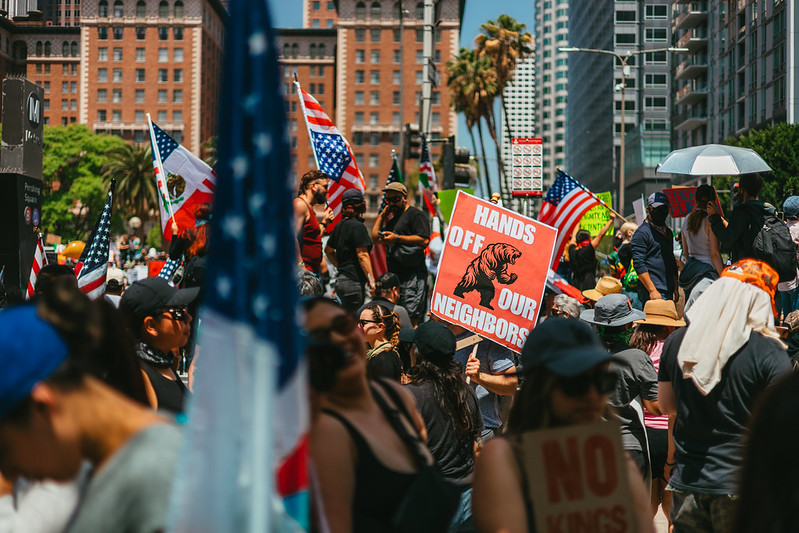
Not even a week later, the “No Kings” marches flooded cities across the U.S.—from Los Angeles to New York—marking the end of a tense and symbolic week. Tens of thousands turned out on a day that was simultaneously Flag Day, President Donald Trump’s birthday, and the 250th anniversary of the U.S. Army. In DC a multimillion-dollar military parade punctuated the event, mere weeks after NEA grants were canceled and proposals threaten to defund the agency altogether.

Once again, I saw colleagues and students—a few of the same people I had just seen at the Tonys—some masked, fearing for their safety- standing face to face with National Guard troops in places where they might have performed in city-sponsored arts festivals. The dissonance between these two images was hard to ignore. And yet, I felt pride again— this time for those reclaiming spaces that have turned hostile.
From my own perspective, some media organization’s portrayals of these protestors as violent agitators fails to tell the whole truth. The people I saw in livestreams and reports were teachers, designers, students, documented and undocumented workers, dreamers—people whose lives and livelihoods are increasingly under threat.
I am an immigrant, but also a newly naturalized citizen. I am an artist based in the U.S. but work across borders and languages. I am the founder of a platform that empowers artists often left out of dominant narratives, and yet I fear for my family, my colleagues, and myself, as the threat of censorship and repression continues to grow.
Like many others, I live between those places—between the Broadway spotlight and the protest line. I rejoice in the victories of those who look like me and still carry the weariness of navigating systems that remain inaccessible. That contradiction itself is the driving force behind Skene: To celebrate our wins while carving out new spaces for visibility.

I believe in nuance. In the messy middle. In the complexity of not fully belonging, yet choosing to build anyway. I celebrate the Tony wins, and I keep watching the streets, mourning the fear that keeps artists masked. I won’t let either version of the story erase the other. Theatre—and art itself—is about presence. And presence doesn’t always translate to recognition. Sometimes it just means being in a space. Continuing to create, to witness, to insist on our stories.
In the spaces between ovation and outrage.