


Skene Year One: From Ghostlight to Global Stage.
Celebrate Skene’s Year One: 1.47M views across 95+ countries. From ghost light to global hub, we’re documenting the labor behind the magic.
Celebrate Skene’s Year One: 1.47M views across 95+ countries. From ghost light to global hub, we’re documenting the labor behind the magic.

A practical guide to beginner ballet gear, from shoes and attire to training tools that support safe, confident technique.

Edella Oroz Westerfield brings imagination, cultural reflection, and vibrant detail to her work as an emerging actress and singer in contemporary theatre.

Argentinian hair aerialist Martina Bakst shares her path through new circus, emotional storytelling, and the discipline of her airborne craft
How the Super Bowl halftime show became a political stage where power identity and performance collide in front of millions.

I’ve never been much of a sports fan. But during grad school, I found myself drawn to football almost by accident. My university had a nationally ranked NCAA team, and the scale of attention and resources surrounding it was impossible to ignore. I remember learning that the head coach’s salary exceeded the entire annual budget of the theatre department combined.
Other international students urged me to attend a game. “It’s a uniquely American experience,” -someone said to me. They were right. Sitting in the stands, surrounded by chanting crowds, coordinated jerseys, and choreographed rituals, I felt the same collective energy I recognized from the theatre. Community, spectacle, and performance folding into one another. And of course, the politics.
I’ve always been skeptical of the claim that performance exists outside politics. When 120 million people are watching the same performance, what we see, what we hear, and who gets to speak matters far beyond thirteen minutes of music. The Super Bowl halftime show is often framed as spectacle, but it functions as one of the most powerful performance platforms in contemporary culture, extending far beyond the United States. What appears on that stage, –and sometimes what doesn’t, reveals how identity, power, and visibility are negotiated in public view.
The halftime show isn’t where politics interrupt entertainment. It’s where politics are translated through it, not unlike Ibsen’s An Enemy of the People or Akhtar’s Disgraced.

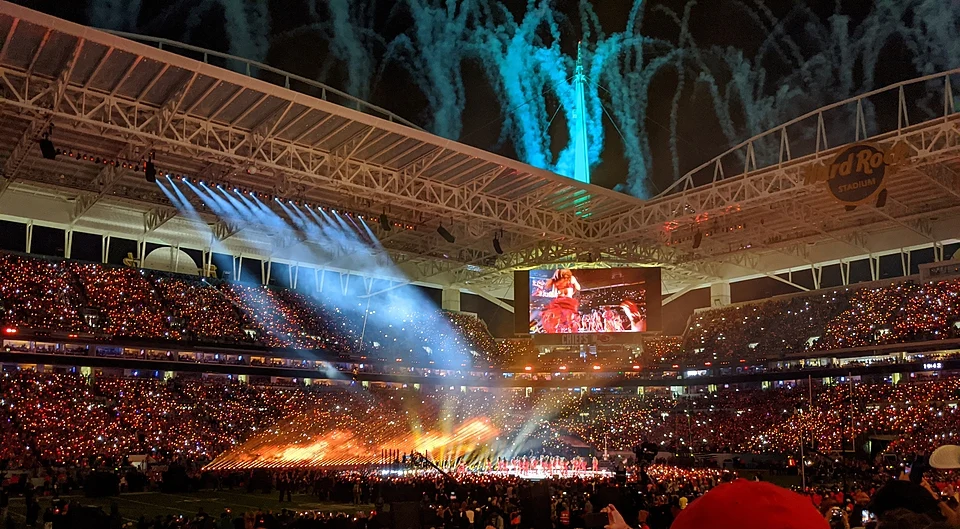
The Super Bowl halftime show reaches an audience unmatched by almost any live cultural event. In 2025, over 120 million viewers tuned in. That scale transforms performance into cultural authorization. To appear on this stage isn’t simply to entertain but to be affirmed as culturally central. This affirmation shapes ideas of belonging and legitimacy at an international level.
Early halftime shows relied on marching bands and patriotic pageantry that reinforced unity without demanding interpretation. As pop artists replaced those forms, the stage became expressive rather than ornamental. Popular music carries identity, language, and lived experience. Once those elements entered the halftime show, neutrality became nearly impossible.
The shift matters because spectacle at this scale doesn’t just reflect culture; it shapes it. When Shakira and Jennifer Lopez performed in 2020, their bilingual performance celebrated Latinx identity at a moment when immigration dominated political discourse. When Beyoncé invoked Black Panther imagery in 2016, her performance sparked national debate about race, protest, and representation. These weren’t accidents. They were deliberate artistic choices on a stage designed to be seen.
Performance communicates politically even when it avoids overt statements. Sound, movement, language, and presence function as political signals. Silence can suggest compliance. Visibility can provoke backlash. Absence feels intentional.
The Super Bowl exists within a tightly managed framework of national identity. Military flyovers, anthems, and rhetoric of unity shape the event long before halftime begins. These choices aren’t incidental. They operate as soft power, reinforcing particular ideas about who belongs and how dissent should be contained. When performers challenge these boundaries, even subtly, institutional discomfort becomes visible.
Who is invited to perform at halftime matters as much as what is performed. Selection reflects institutional comfort with race, language, gender, and cultural affiliation. Visibility on this stage is conditional and carefully negotiated. The NFL controls access, and that gatekeeping reveals whose stories are considered safe, profitable, or palatable.
Backlash often reveals these limits too. Complaints framed around unity or tradition usually signal anxiety about shifting cultural power. The halftime show then becomes a contested space where representation is debated under the guise of taste and appropriateness.
Like in theatre, audiences don’t consume the halftime show passively. They read it. They decode gestures, lyrics, costumes, and framing through personal and political lenses. A few minutes of performance can absorb years of cultural tension. The halftime show doesn’t end when the music stops. It continues through social media, commentary, and public debate. Meaning accumulates through collective attention.

This year’s halftime show became politically charged long before Super Bowl Sunday. Bad Bunny’s recent appearance at the Grammys, where he spoke openly about immigration enforcement and identity visibility, sharpened public attention on his role as more than an entertainer. His words circulated widely and were closely scrutinized, positioning him as a cultural figure willing to speak when others remain cautious.
The announcement of his Super Bowl performance intensified existing tensions. Conservative commentators framed his selection as a threat to what they described as a unifying American tradition, focusing particularly on language and cultural affiliation. The backlash wasn’t subtle either. Spanish language performance itself was treated as political provocation.
In response, Turning Point USA announced an alternative All American Halftime Show featuring Kid Rock, explicitly marketed as counterprogramming. The existence of this parallel halftime event underscores just how thoroughly performance had become a proxy battleground for cultural politics.
Stakes escalated further when President Trump announced he would not attend the Super Bowl, a decision widely understood as connected to the halftime controversy. The absence of the president from the nation’s most visible cultural ritual added institutional weight to what had already become a symbolic conflict.

By the time the lights rose, this halftime show already carried layered meaning. It was never only about what Bad Bunny would perform, but about what his presence represented. Supporters read the moment as overdue recognition for audiences long present but rarely centered. Critics framed it as disruption. Even before a single note played, the language spoken on stage, the bodies occupying it, and the expectations placed upon them signaled shifts in cultural power.
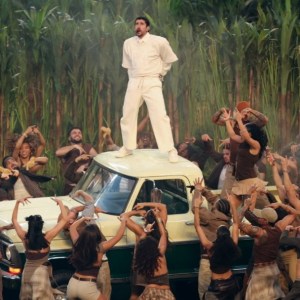
When the performance began at Levi’s Stadium, it unfolded not simply as music but as a carefully staged cultural statement. Bad Bunny opened dressed in white, grounding the show in imagery drawn from Puerto Rican life. Sugar cane fields, Caribbean movement, and scenes of communal gathering framed the performance. Guest appearances by Lady Gaga and Ricky Martin expanded the narrative into cross cultural collaboration, culminating in songs that foregrounded Latin American presence on one of the most visible stages in the world.
Symbolism surfaced throughout. Messages of collective belonging appeared alongside gestures that linked cultural identity to the language of the event itself. This was not a setlist of party anthems. It was a performance built around presence, visibility, and shared narrative. Without naming institutions directly, the show enacted meaning that extended far beyond the music.

The Super Bowl halftime show does not simply reflect culture. It shapes it. What audiences see and how they interpret it becomes part of the performance itself. The idea of neutrality dissolves the moment the first note plays.
This is why the halftime show functions as political theatre. It operates within institutional frameworks that define national identity. It grants visibility selectively. It invites millions to read meaning into every gesture, costume, and silence. Political theatre does not require manifestos. It only requires a stage large enough that who stands on it matters.
The performance ends. The politics do not.
If you want to go deeper into how performance, politics, and institutions shape one another across different contexts, check out Inside the Decision to Rename the Kennedy Center After Trump, and how artists continue creating under pressure in Todo en Contra: Comunidades de Resistencia y el Teatro que Crece en las Grietas, or read our examination on the stakes and consequences of making work that openly engages power in The Risk of Political Art.
Support artists—share this
Get our free Survival Guide for Actors, Directors, and Designers.


We use cookies to personalize content, provide social media features, and analyze our traffic. You can manage your preferences or accept all.
Get our free Survival Guide for Actors, Directors, and Designers.