Sacred Hidden Symbols: The Most Ancient Religion.
Jay Duckworth explores theater’s sacred origins, tracing how performance began as ritual and endures as humanity’s oldest art.

Jay Duckworth explores theater’s sacred origins, tracing how performance began as ritual and endures as humanity’s oldest art.

In-depth interview with director Rebecca Miller Kratzer on collaboration, intuitive process, and redefining leadership in theatre.

Composer Jaimie Pangan on discipline, indie storytelling, and creating music that connects emotionally across film and games.

Explore how meditation and mindfulness can support theatre artists with focus, presence, emotional regulation, and creative sustainability.

Mexican artistic director Rebeca Garro reflects on theatre as a tool for social change community engagement and ethical storytelling.
War is not an aberration. It is a system. One we’re all immersed in. Active invasions. Proxy conflicts. Record-breaking military budgets approved with barely a debate. Politicians speak of security while corporations report record growth. Civilian deaths are converted into statistics, then footnotes, then nothing. The language of necessity is carefully designed to mask the machinery beneath it, and that machinery runs continuously, in peacetime and in war.
For reasons that should be obvious to all, the threat of war has been heavy on my mind this year. In this space of pain and confusion I often interrogate the relevance of my work. Of art. Of theatre in general. What is this all for? — I ask myself. And then I remember.
In 1993, Sarajevo was under siege. The city had been surrounded, shelled, and starved for over a year. Into that reality, Susan Sontag chose to stage Samuel Beckett’s Waiting for Godot. Rehearsals happened between bombardments. The cast were themselves living the siege. They understood waiting and absurdity not as dramatic metaphors but as the texture of their daily lives. Performances went ahead without electricity, by candlelight, for audiences who risked their lives to attend. Sontag later recalled the production as one of the most important things she had ever done. Not because it changed the war (— it didn’t). But because it declared, in the middle of a sustained attempt to destroy a city’s people and culture, that human thought cannot be shelled into submission. That art persists. That theatre at its most serious is not escape. Not entertainment. It bears witness.
Theatre has always been a platform for the voices opposing war. The six plays below do not glorify conflict. They dissect it, each targeting a different mechanism of the war machine: profit, civilian devastation, political rhetoric, institutional dehumanization, and gendered violence. Across centuries and continents, they’ve tried to make the system visible in ways that news cycles and policy papers cannot.
Whether you’re programming your next season, looking for ways to educate your community, or simply need inspiration in these tense and uncertain times, these six plays offer a place to start.
Please note: the works on this list deal with war, sexual violence, trauma, institutional cruelty, and other intense subject matter. Reader and audience discretion is advised.

Written in 1939 and set during the Thirty Years’ War, Brecht’s masterwork follows Anna Fierling, known as “Mother Courage,” a canteen woman who hauls her wagon through a continent at war, believing she can profit from conflict without being consumed by it. She is wrong. One by one, each of her three children is lost to the same war that feeds her. What makes the play radical is Brecht’s refusal of sympathy. His “alienation effect” uses jarring songs, placards announcing each scene’s outcome in advance, and actors visibly changing costumes onstage to prevent the audience from settling into emotional comfort. We are meant to think, not weep. War, Brecht insists, is not tragedy alone. It is commerce. It continues because it pays. Widely regarded as one of the greatest plays of the 20th century, Mother Courage is as urgent as any war correspondent’s dispatch.
Written around 415 BCE in the immediate aftermath of Athens’ brutal massacre of the people of Melos, The Trojan Women is a work of devastating political precision. There are no battle scenes. Troy has already fallen. What Euripides shows us is the residue: women divided as war prizes, a child executed to prevent future rebellion, a queen stripped of everything but her grief. Hecuba, Cassandra, Andromache, and Helen each carry a different dimension of what conquest actually costs. Euripides relocates war from the battlefield to the bodies and minds of those left behind, rendering victory indistinguishable from moral collapse. Performed just before Athens launched the disastrous Sicilian Expedition, the play was a warning that went unheeded. It remains one.
Often staged as patriotic triumph, Henry V rewards closer reading as something far more unsettling. Henry is a gifted rhetorician and his St. Crispin’s Day speech is among the most stirring in the English language, but Shakespeare places that eloquence directly alongside scenes of threatened massacre, soldiers questioning their king in disguise, and a court calculating the theological justification for war like a legal brief. Charisma becomes policy. Language transforms conquest into destiny. The play asks how leaders construct consent for violence and how institutions launder moral ambiguity into national pride. Productions that lean into the play’s darkness, its exhausted soldiers, its civilian casualties, its hollow victories, find a work that speaks directly to contemporary military culture and political spin.
Written in the 1830s and left unfinished at Büchner’s death at age 23, Woyzeck is perhaps the most modern play on this list. Its protagonist is a low-ranking soldier who is poor, uneducated, and completely at the mercy of systems that regard him as material rather than human. His commanding officer lectures him on morality he has no resources to practice. A doctor uses him as a subject for dietary experiments, gleefully documenting his deterioration. His only relationship unravels under the pressure of poverty and jealousy, leading to murder and psychological collapse. Büchner offers no heroism, no redemption, no battlefield glory. The machinery of war begins with obedience, hierarchy, and the belief that certain lives are expendable. Woyzeck shows exactly how that belief is manufactured and what it costs.
Winner of the 2009 Pulitzer Prize for Drama, Ruined is the only play on this list drawn directly from living testimony. Nottage and director Kate Whoriskey traveled to the Democratic Republic of Congo to interview women survivors of conflict-related sexual violence. What emerged is a work set in Mama Nadi’s bar and brothel, a fragile sanctuary amid civil war, where women negotiate survival daily. The title carries a double meaning, referencing both general ruin and the Congolese term for women whose bodies have been permanently damaged by sexual assault used as a deliberate weapon of war. Nottage reveals a dimension of armed conflict almost never addressed in official narratives: intimate, generational, and ongoing. The war is not background. It is the main character. And its victims are not statistics but women with names, histories, and an insistence on being seen.
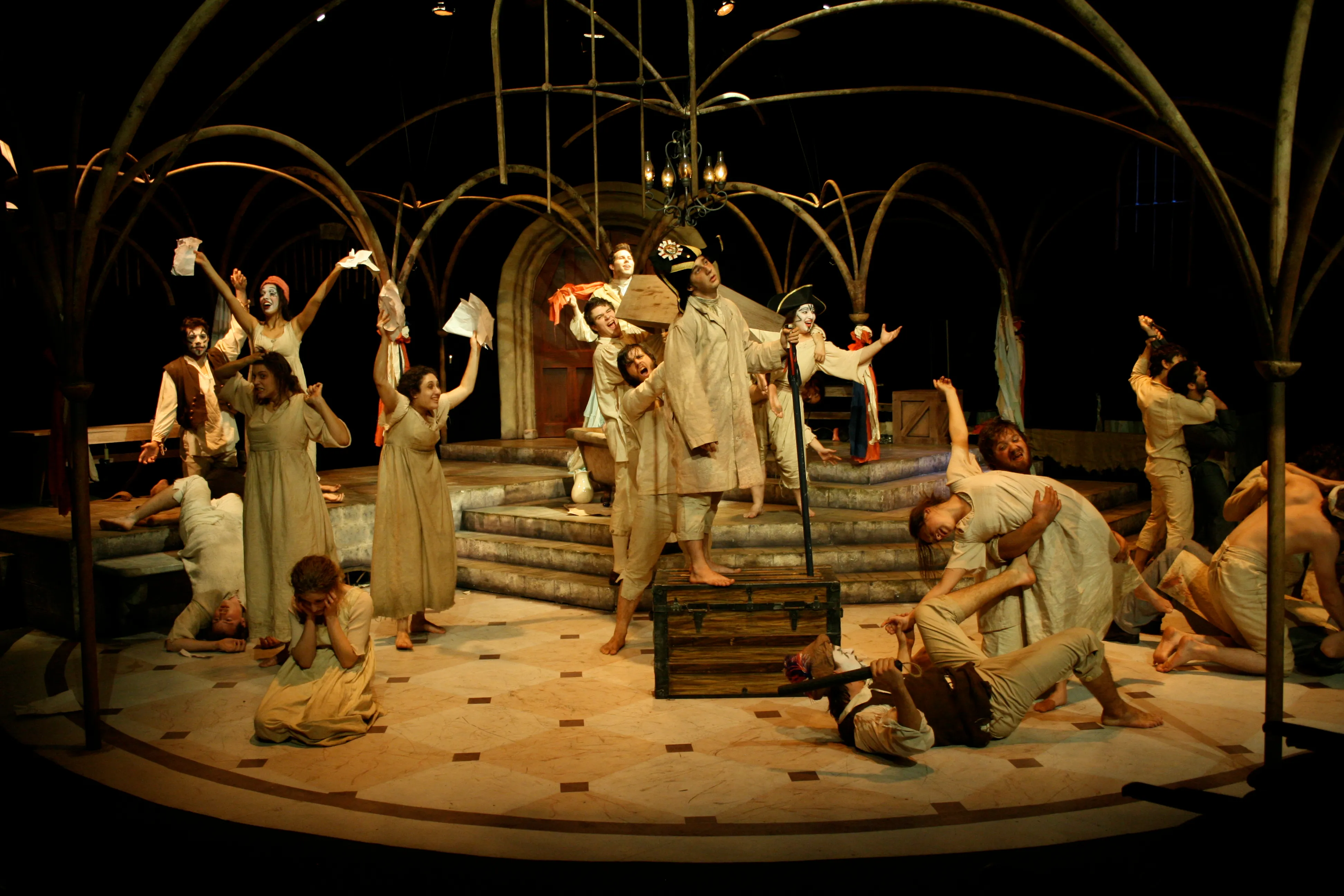
Written in 1963 and first staged in West Berlin the following year, Marat/Sade is one of the most formally audacious political plays of the twentieth century. Its full title tells the story: The Persecution and Assassination of Jean-Paul Marat as Performed by the Inmates of the Asylum of Charenton Under the Direction of the Marquis de Sade. The setting is 1808. Napoleon rules. The revolution is over. Inside a mental institution, the Marquis de Sade directs his fellow inmates in a reenactment of Marat’s assassination fifteen years prior. The result is a play within a play, in which revolutionary idealism and philosophical nihilism argue directly with each other, neither winning, neither conceding. Marat believes in collective action and the necessity of violence to dismantle oppression. Sade believes only in the individual, in desire, in the futility of any system claiming to liberate humanity. Weiss does not resolve the argument. That is the point. The chaos builds until the inmates can no longer separate the drama from their own reality, and the stage breaks apart entirely. Peter Brook’s landmark 1964 RSC production, with Glenda Jackson and Patrick Magee, made the play internationally famous and remains one of theatre’s defining moments. The war machine here is not military. It is ideological, and Weiss understood that ideological fervor and organized violence are rarely far apart.
Across centuries and continents, these six works converge on a single truth: war survives through systems. It is financed. It is narrated. It is justified. It is institutionalized. It devastates civilians and consumes the vulnerable. It reshapes language itself.
In 1984, George Orwell wrote: “The war is not meant to be won. It is meant to be continuous.” It is structured to be sustained, negotiated, and monetized. Now more than ever, theatre that speaks truth to power is not merely cathartic. It bears witness. In a time when conflict is normalized and militarization is marketed as stability, these plays restore the human cost that official language erases. They resist forgetting.
It is an act of civic memory.
Support artists—share this
Get our free Survival Guide for Actors, Directors, and Designers.
We use cookies to personalize content, provide social media features, and analyze our traffic. You can manage your preferences or accept all.