







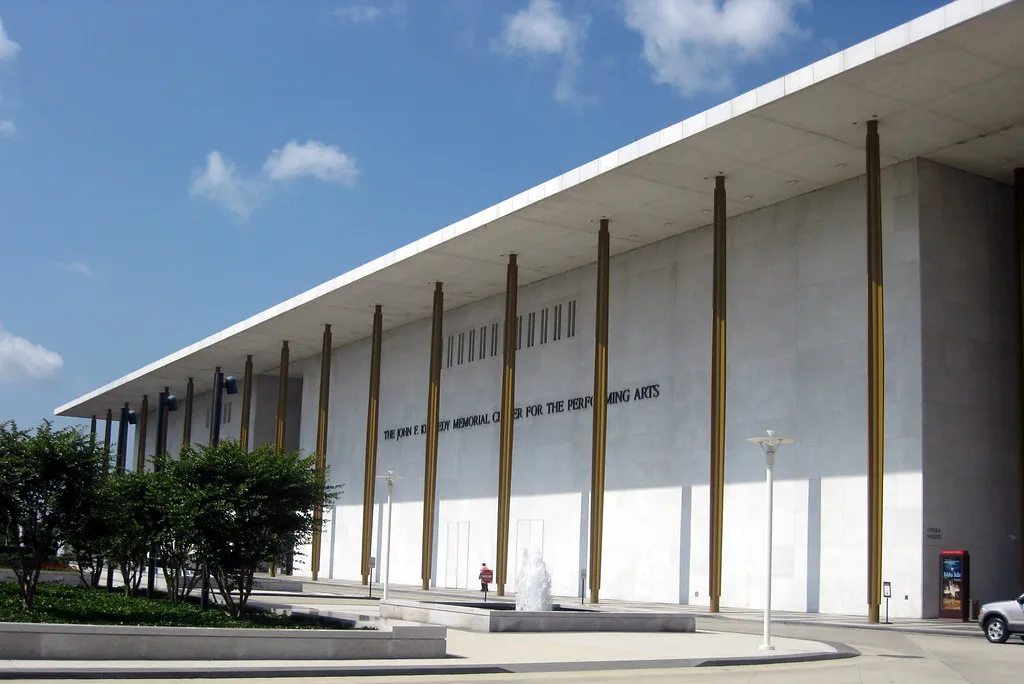

On December 18, 2025, the board governing the John F. Kennedy Center for the Performing Arts voted unanimously to rename the institution the Trump Kennedy Center. The announcement was shared publicly by White House Press Secretary Karoline Leavitt, who said the decision was intended to recognize President Donald J. Trump’s role in stabilizing and rehabilitating the building through federal and private funding initiatives. Reporting by Reuters characterized the move as a recognition of Trump’s involvement in preserving the institution’s operations and infrastructure.
The decision represents a significant symbolic shift for one of the most prominent cultural institutions in the United States and follows a year of substantial changes to the Kennedy Center’s governance and leadership structure.
Origins of a National Cultural Institution
The Kennedy Center was authorized by Congress in 1958, with legislation signed by President Dwight D. Eisenhower, establishing a national cultural center for the performing arts in Washington, D.C. The venue officially opened on September 8, 1971, after more than a decade of planning and construction. Following the assassination of President John F. Kennedy, Congress voted in 1964 to rename the center in his honor, designating it as a living memorial to a president known for his public advocacy of the arts.
According to the institution’s historical record, the Kennedy Center has served as the home of the National Symphony Orchestra and the Washington National Opera, while also presenting ballet, theater, jazz, contemporary music, and large scale national events. Among its most visible programs is the annual Kennedy Center Honors, which recognize lifetime achievement across disciplines including music, theater, dance, film, and television.
Over more than five decades, the center has hosted thousands of performances and showcased tens of thousands of artists from the United States and around the world, positioning itself as a central platform for both established and emerging voices in the performing arts.

The 2025 Board Reorganization and Vote
The path to the renaming began earlier in 2025, when President Trump reorganized the Kennedy Center’s board of trustees. As reported by The Washington Post, all 18 sitting board members were dismissed and replaced with presidential appointees. Shortly afterward, Trump was elected chairman of the board.
Under this new governance structure, the board voted unanimously to rename the institution the Trump Kennedy Center. Reuters reported that the board cited Trump’s financial and administrative involvement as justification for the decision, framing the change as an acknowledgment of his role in sustaining the center during a period of transition.
Despite the board’s vote, the renaming has raised questions about legal authority. Federal law establishing the Kennedy Center identifies it as the John F. Kennedy Memorial Center for the Performing Arts. Legal scholars cited by The Washington Post have noted that changes to federally designated memorials typically require congressional approval, meaning the board’s action could face legislative or judicial scrutiny before the name change is formally codified.
Members of the Kennedy family have publicly objected to the renaming, arguing that it alters the original intent of the memorial and weakens its symbolic association with President Kennedy’s legacy. These objections have contributed to a broader public debate about institutional independence, historical preservation, and the role of political leadership in shaping national cultural spaces.

What It Means Going Forward
Throughout its history, the Kennedy Center has functioned not only as a performance venue but also as a national cultural symbol. Its stages have featured orchestras, opera companies, touring Broadway productions, international artists, and education initiatives aimed at expanding access to the arts. The Kennedy Center Honors, first presented in 1978, have become one of the most visible annual celebrations of artistic achievement in the United States, broadcast nationally and attended by artists across generations.
This long standing role has positioned the center as both a cultural gathering place and a reflection of evolving national values around art, expression, and public life.
The renaming of the Kennedy Center introduces new uncertainties for the institution and the broader performing arts community. Observers have noted that the move signals a closer alignment between federal political leadership and a national arts organization, raising questions about institutional autonomy, programming priorities, and long term governance.
Legal challenges or congressional review may ultimately determine whether the Trump Kennedy Center name becomes permanent under federal law. In the meantime, artists, audiences, and cultural organizations are closely watching how leadership changes will influence the center’s role as a platform for diverse artistic expression and national cultural dialogue.
As one of the most visible arts institutions in the country, any shift in its identity carries implications not only for its own future but also for how public culture is shaped, funded, and remembered in the United States.