Emilio Zurita
cOsmO
2025
Theatre for Young Audiences
produced by Motus Theatre
What does the cosmos look like through the eyes of a child? That question launched cOsmO, an international theatrical creation for young audiences that unfolded between Mexico and Canada over the course of two years. Inspired by Jorge Luján’s picture book Trompa con Trompita, the project began as a gentle meditation on parent-child relationships in the animal kingdom. But as workshops with children from both countries shaped the direction of the work, cOsmO grew into something much larger—a theatrical universe that explores creativity, natural cycles, and our place in the vast fabric of the cosmos.
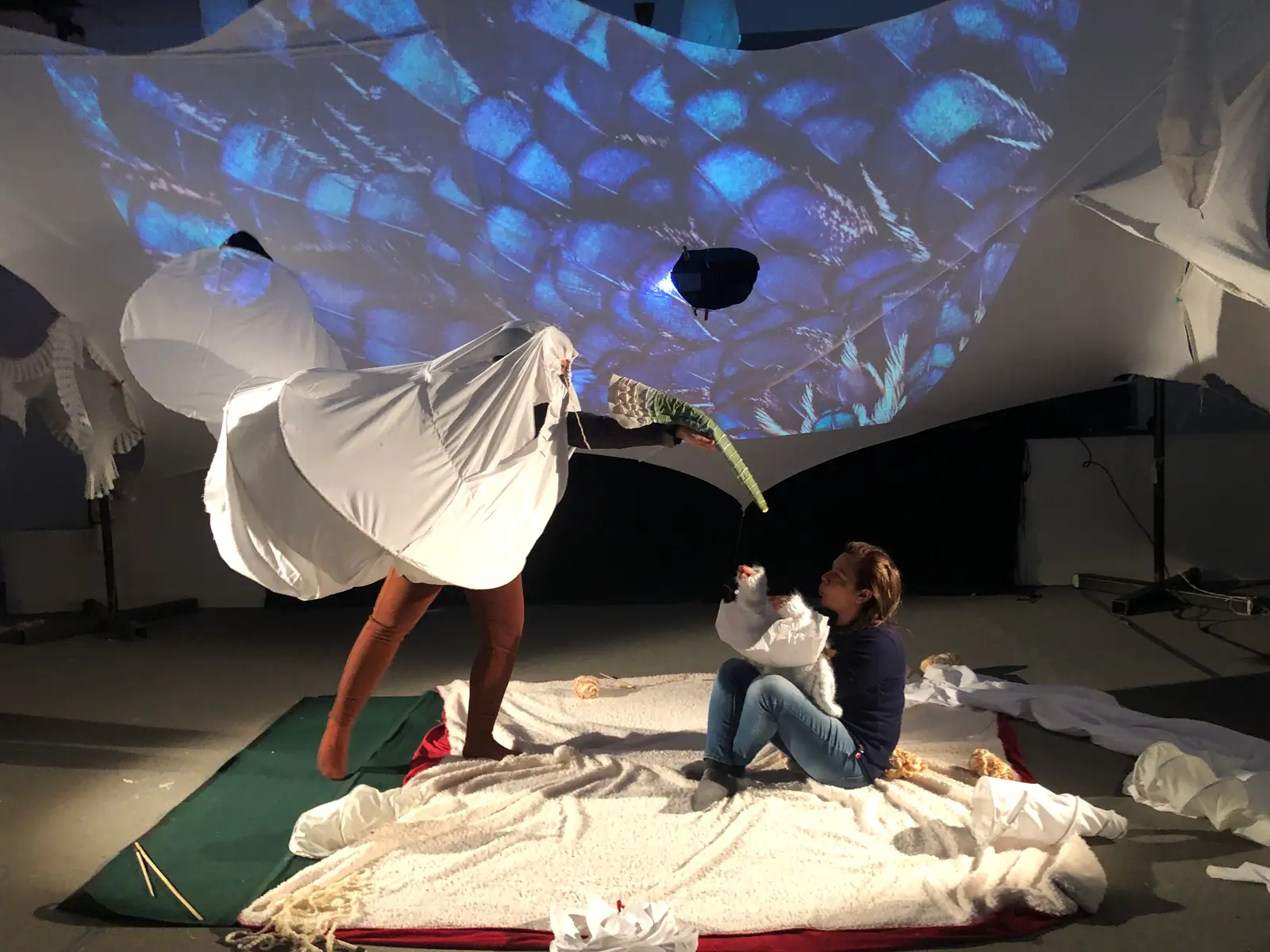
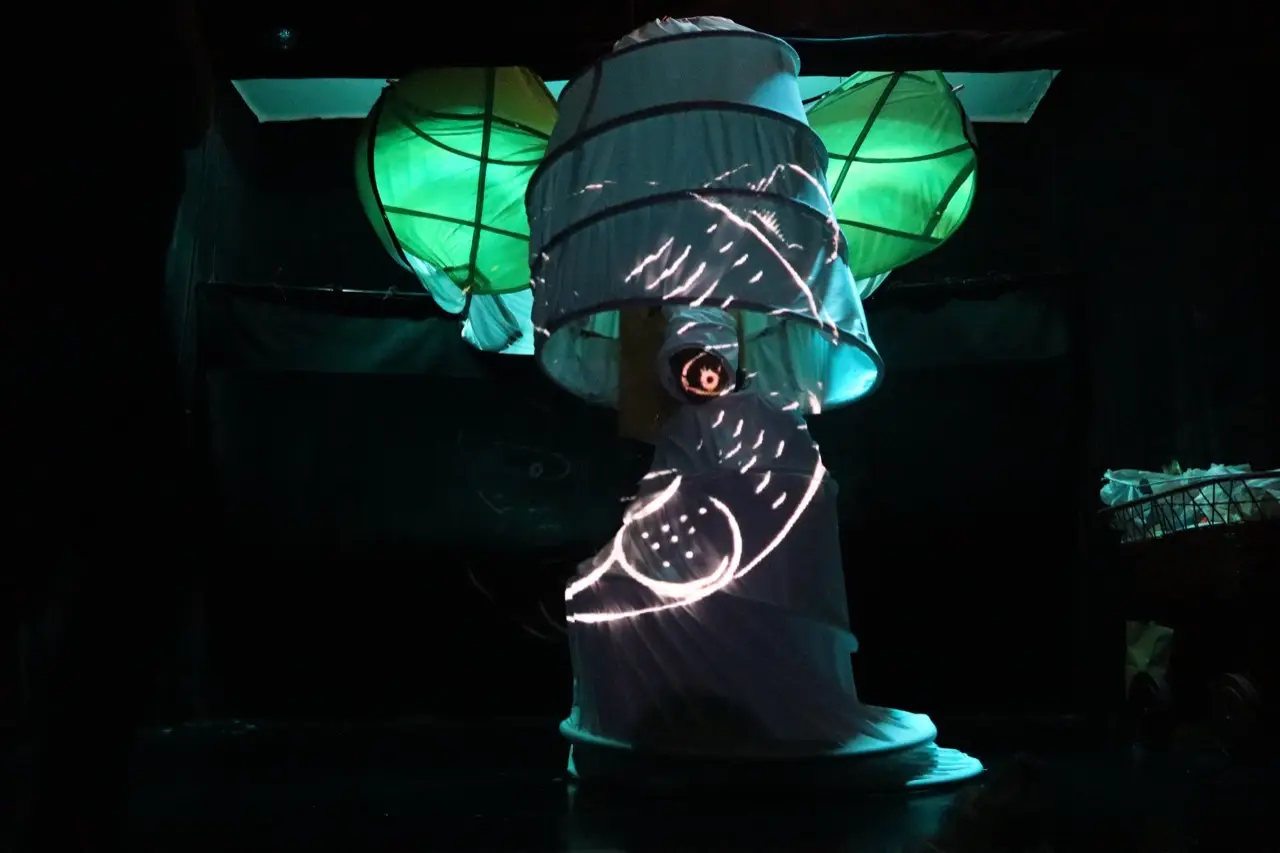
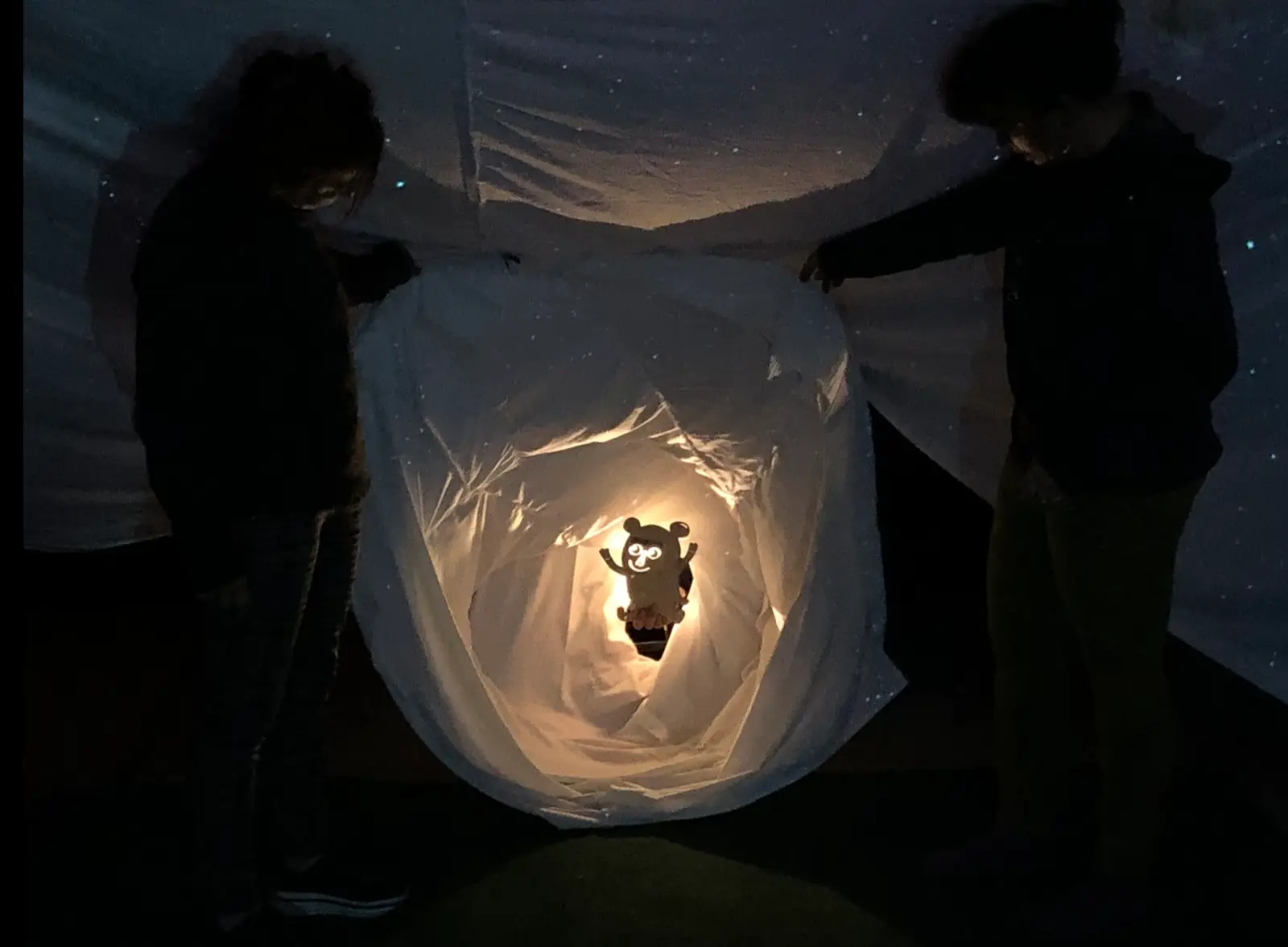
Blending recycled materials, live performance, puppetry, and multimedia, cOsmO is a truly collaborative exploration of space—both physical and emotional. Designed with and for children ages 3 to 9, the project invites its audiences to see, touch, and move within a shifting theatrical landscape built from repurposed fabrics, suspended structures, and poetic imagery. It’s not just a performance; it’s a living, breathing world that encourages young minds to ask questions, dream big, and discover wonder in the ordinary. At its heart, cOsmO is an invitation: to explore, to imagine, and to feel the rhythms of the universe in your own body.
In this edition of DIARIES, cOsmO designer and World Stage Design 2025 finalist Emilio Zurita takes us from its conception to the discoveries in its audience reactions.

I. Research, Inspiration & Planning
Este proyecto para primeras infancias usó como primera semilla el libro Trompa con Trompita de Jorge Luján. El libro comunica con lenguaje visual y hermosas imagenes las relaciones de paternidades y maternidades en el mundo animal. Después de varios talleres en la Ciudad de México y Montreal el proyecto fue adquiriendo su propia identidad, voz y estructura dramática y cambió de narrativa para enfocarse en los temas de creación y creatividad, los ciclos y elementos naturales.
cOsmO fue abordado como un nuevo proyecto de investigación que involucró talleres con primeras infancias de México y Canadá. Exploramos materiales reciclados y reutilizados de mercados de pulgas locales. Experimentamos con proyecciones, el software Isadora e imágenes de la naturaleza y los animales. Nos interesaba explorar los temas de creatividad, ciclos naturales, el día, la noche, el cosmos y las nociones de lo micro y lo macro.
This project for young audiences used the book Trompa con Trompita by Jorge Luján as its seed material. The book communicates parent-child relationships in the animal world through visual language and beautiful imagery. After several workshops in Mexico City and Montreal, the project began to develop its own identity, voice, and dramatic structure, shifting its narrative to focus on themes of creation and creativity, natural cycles, and the elements.
cOsmO was approached as a new research project that involved workshops with young children in both Mexico and Canada. We explored recycled and repurposed materials sourced from local flea markets. We experimented with projections, Isadora software, and images of nature and animals. Our interest centered around themes of creativity, natural cycles, day and night, the cosmos, and the notions of the micro and the macro.


II. Pre-Production & Rehearsals
El reto más grande fue que, como abordamos esta pieza como una pieza de creación original, la estructura dramática (el “texto”) se fue desarrollando al mismo tiempo que el proceso de creación. Por esta razón, nuestro proceso de investigación fue extenso y requirió mucha disciplina y paciencia. Nos vimos obligados a sacrificar muchas buenas ideas y prototipos para poder quedarnos con lo que la obra necesitaba. El espectáculo fue el resultado de dos años de creación y talleres con el equipo internacional que sucedieron aproximadamente cada seis meses tanto en México como en Canadá.
El salto del primer taller a la conceptualización del dispositivo escénico que diseñé fue muy emocionante. El dispositivo, que consiste de una manto tensado hecho de telas reutilizadas que se puede reconfigurar con un sistema de poleas, le otorgó al proyecto espacio, estructura y, de alguna manera, dramaturgia. Una vez que definimos el espacio logramos crear una linea narrativa para cOsmO.
The biggest challenge was that, since we approached this as an original creation, the dramatic structure (the “text”) developed simultaneously with the creative process. For this reason, our research process was extensive and required a great deal of discipline and patience. We were forced to sacrifice many good ideas and prototypes in order to keep only what the piece truly needed. The final performance was the result of two years of creation and workshops with an international team, held approximately every six months in both Mexico and Canada.
The leap from the first workshop to the conceptualization of the scenic device I designed was incredibly exciting. The device, made up of a tensioned canopy constructed from repurposed fabrics that can be reconfigured using a pulley system, gave the project space, structure, and in a way, dramaturgy. Once we defined the space, we were able to create a narrative arc for cOsmO.


III. Production & Audience Response
Este es uno de los proyectos más colaborativos que he logrado hacer y la sinergia entre las creadoras, las diseñadoras de títeres y yo como escenógrafo, iluminador y diseñador de video fue total.
¡Hubo muchos descubrimientos! En el proceso fue fascinante trabajar con infancias de 3 a 9 años y escuchar sus perspectivas sobre nuestra creación. Había muchos elementos que creíamos que se iban a comunicar de una manera que se terminaron comunicando de otra completamente distinta. El objetivo principal de este proyecto era fomentar la curiosidad y creatividad de los niños y ha sido un gratificante ver la diversidad de respuestas y apreciación a las imágenes que creamos con el espacio.
This is one of the most collaborative projects I’ve ever had the chance to work on, and the synergy between the creators, the puppet designers, and myself as scenographer, lighting designer, and video designer was complete.
There were so many discoveries! Throughout the process, it was fascinating to work with children ages 3 to 9 and hear their perspectives on our creation. There were many elements we thought would communicate in a certain way, but ended up being understood in entirely different ways. The main goal of this project was to foster children’s curiosity and creativity, and it’s been incredibly rewarding to see the diverse responses and appreciation for the images we created with the space.
About the Artist

Emilio Zurita
He/Him
Scenographer
Emilio Martínez Zurita de la Garza is a scenographer and lighting designer from Mexico City, born on March 20, 1990. He graduated in 2013 with a bachelor’s degree from Ithaca College and has worked on a wide range of scenic and lighting design projects for theatre, dance, opera, television, and live arts in Mexico, the United States, Canada, Europe, and South America. He is a World Stage Design 2025 finalist in Performance Design.
Notable projects include the design of Prima Facie, cOsmO, Clue!, Indecente, Ana contra la Muerte, La Voz Humana, Visitando al Señor Green, Ciudad Luminosa, Lotería Rusa: Chéjov en Cachitos, El Juego: o la Revancha Perpetua, and No Ser Sino Parecer.
Collaborators
- Concept, direction and acting: Haydeé Boetto and Hélène Ducharme
- Assistant director: Mathilde Addy-Laird
- Set, video and lighting design: Emilio Zurita
- Puppets, props and costumes: Pavla Mano
- Music and soundscape: Raúl Zambrano
- Rigging design: Marc “Marcus” Gauthier
- Lighting design: Gabriel Duquette
- Production manager: Danaëlle Ducharme-Massé
- Production assistants: Luisa Márquez and Mariana González
- Transverse flute: Araucaria Guzmán
- Soundtrack post-production: Raúl Zambrano, Araucaria Guzmán y Sergio Bátiz
- Stage management: Justin Lalande and Gaspard Philippe
- Technical coordination in Mexico: Gabriel Enciso