


Estefania Perez-Vera
2019
Dance/Performance
produced by Virginia Tech
In 2019, Body, Full of Time premiered in The Cube at Virginia Tech, presenting audiences with a vivid, genre-blending performance that explored the relationship between the human body and the digital world. Conceived by choreographer Scotty Hardwig and visual artist Zach Duer, with music by Caleb Flood and animations by Nate King, the work was a groundbreaking fusion of motion-capture technology, real-time projection, and live contemporary dance. At its heart was the question: How can one stage a sample of humanity? As projections of code-driven animations flooded the walls and floor, performer Scotty Hardwig moved through an environment shaped as much by digital abstraction as by the organic presence of his own body.
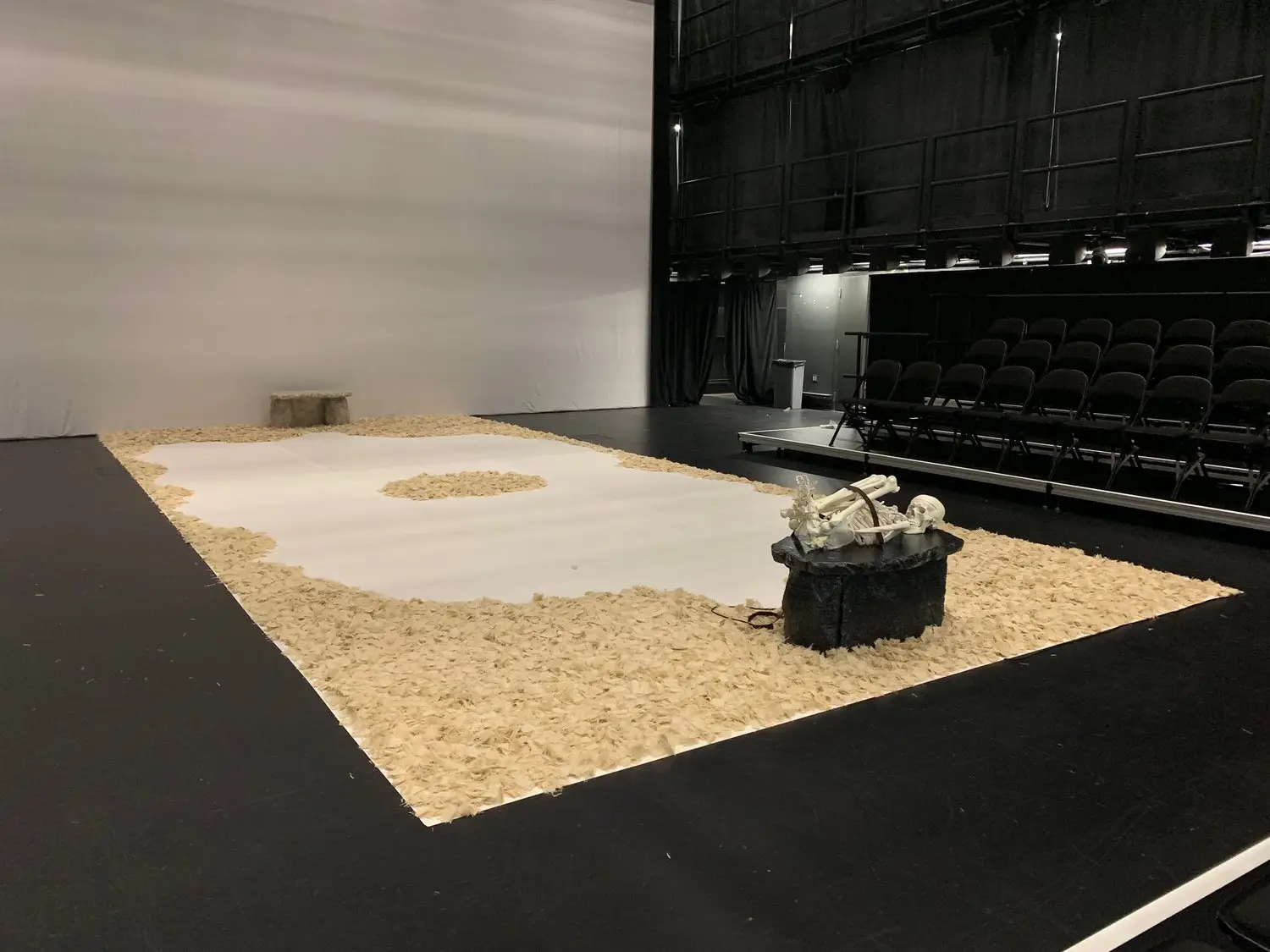
Designing the physical world of Body, Full of Time meant navigating this unique digital-human dialogue. Without a script or linear narrative to guide the process, scenographer Estefania Perez-Vera had to respond directly to the creative discoveries unfolding in real-time rehearsals—where choreography, music, and digital media evolved in tandem. Grounded in themes of ritual and early human expression, the design emerged from deep historical research and was developed collaboratively in the rehearsal studio itself. What followed was a process rooted in adaptability, experimentation, and the shared goal of making the ephemeral feel tangible.
In this edition of DIARIES, we step inside that creative process—where collaboration, intuition, and experimentation turned vision into visceral reality.


Body, Full of Time Initial Costume Sketches, source: Estefanía Perez-Vera
I. Research, Inspiration & Planning
For Body, Full of Time, the concept for the stage design centered around the question of how to create a sample of humanity on stage. As Scotty Hardwig (the artistic director and performer of the work) described it to me, the performance was all about the relation between the human and the digital world. This digital world was represented by massive projections and animations covering the floor and the horizon of the space. The challenge for me became how to represent the human side: how to encapsulate humanity in every element of the physical scenic elements without being hyper specific to one culture. My research took me back in history, to the very early years of civilization, and it was fascinating to realize that in the beginning, human expressions of material culture shared many similarities with one another, despite the geographical divisions and the different regional conditions. The element of “ritual” became a core theme throughout the conception of the scenic elements, the costume pieces, and the lighting design. Having that in mind certainly narrowed down my exploration and began to shape what eventually became the final design for the performance.
Constant and clear communication with Scotty and the rest of the creative team was key to the making of Body, Full of Time. The project relied on the visual performance of a solo dancer interacting with the scenic elements on stage and the digital projections. It was clear from the start that such interactions –the relationship between the human figure and the environment surrounding it– were to be the focus of the performance. The challenge with that was that every discovery made in the rehearsal room became a determining factor for the material world around the performer. In that sense, this project was unique in that most of my design explorations happened inside the rehearsal room while seeing the dance choreography being develop in parallel to the music and the projections. There wasn’t a script or a recording I could just sit down at my place and analyze. Body, Full of Time, being an original work of contemporary dance, required a different approach. Unlike other productions, I spent much of my time during the design process at the studio where the choreography was being rehearsed, where the music was being developed, and where the motion capture was being done. All of this was what I needed to understand the physical and conceptual needs for the performance. The work in the making served as my script. And yet, all of us –performance, projections, music, stage design– had a limited amount of time to produce this work. I believe the reason we succeeded, and why it was also a very enjoyable process, was because of the organic and rich collaboration that developed among all the members of the team.

II. Pre-Production & Rehearsals
The biggest challenge for me was to adjust to the working approach this particular project was asking from me. As a scenic designer for the theatre, I feel one gets used to having some sort of written document –a script of some kind– that outlines the logistics of the show: number of locations, transitions, and what not. Body, Full of Time, in contrast, was a very visual work, not only due to its nature as a contemporary dance, but also in the way it was being conceived. Everything was being tailored-made for the performance, down to the choreography itself. There was no previous work to start from; every element was being conceived and developed specifically for this performance, for the very first time. My task was to adjust and figure out my own design process outside of my usual modus operandi. This challenge also came with many positives, though. Working for a fully-original piece gave me ample room for exploration, and Scotty and the others were very generous with their collaboration, placing their trust while also allowing me to have a lot of creative freedom for experimentation. In retrospective, I think that is what made the process so enjoyable to me. At the end of the day, we were all exploring new ideas together, and we worked those ideas into a very cohesive work, both formally and conceptually.
There were multiple pivotal moments during our explorative process. I’d say there was always an “aha!” moment during every rehearsal. Regarding the stage design, a crucial moment was determining the materiality of the scenic elements and their relation to each other within the performing space. There were going to be motion capture-based animations being projected directly onto the entire stage and onto a projection screen that covered one full wall of the space. These projections were supposed to represent the manifestation of the abstract “digital world.” My challenge as stage designer was to come up with the “human, organic world” to balance the digital. Moreover, in talks with Scotty and the other members, the idea that the organic world could have the capacity to change through human action –in contrast to how human action would eventually be controlled by the digital world– became an important theme to explore. Such decision became pivotal to the stage design, as it guided the direction of every decision and experiment made in order to accomplish such quality. This led to the choice of creating a layout inspired in the Japanese Zen garden, using pieces of burlap fabric cut in very small squares instead of sand. The burlap particles would move and disrupt the original layout with every action of the dancer, leaving a physical trace of the human presence in the space. Another quality of this choice was that no performance would be the same, as the burlap particles would produce a different layout at the end each show every night.

III. Production & Audience Response
Collaboration was fundamental for this project. Every element in the show was conceived in relation to the other departments –choreography, music, projections, and stage (scenic, costume, lighting) design. No idea was isolated to one department only. Every suggestion and proposal was shared with all the members of the production team, as any change from any of the creative departments could and would affect the work of the others.
The audiences were very responsive during the three nights Body, Full of Time was performed. We know our audiences were engaging with the performance in part from the feedback we received during a Q&A session after the final night, where audience members would ask the team specific inquires about what they were most curious about after experiencing the show, or comment about their own interpretations of the work.

About the Artist

Estefania Perez-Vera
She/Her
Scenic Designer & Scenic Artist
Estefanía Pérez-Vera is a Mexican scenic designer and scenic artist committed to creating immersive, emotionally resonant environments for the stage. Drawn to performance from an early age, she was captivated by the transformative power of shared audience experiences in theatre, dance, and film. Her design process is deeply intuitive and grounded in research, experimentation, and collaboration, allowing each project to evolve organically. Estefanía’s work reflects her belief in theatre as both a space for connection and a mirror to society. Despite facing challenges tied to gender, socio-economic barriers, and industry pressure, she has forged a purposeful and resilient creative path.
Collaborators
- Artistic Director & Performer – Scotty Hardwig
- Visual Director – Zach Duer
- Scenography – Estefania Perez-Vera
- Music – Caleb Flood
- Animation – Nate King